This post is a comparison of two separate translations of a late Hölderlin Hymn, written between 1801 and 1806, the period just prior to his hospitalization for insanity. I was drawn to this particular poem after reading Martin Heidegger’s book Introduction to Metaphysics. Heidegger ends his book with a reference to this poem.
The poetic usage of the weed in this poem I find resonant on a number of levels. Weeds often grow in the cracks and crevices of the world, in the desolate spaces caught between the functions of space and human purposes. It feels true to me that this is also the space of poetry; the life that emerges in the gaps between what has definable purpose. In my own life poems seem to emerge from the gaps in my intellectual consciousness, from the regions that are untended – from time to time some ungovernable expression of life shoots forth and demands recognition.
I’ve held this Hölderlin poem in mind as I’ve lived this past summer, observing weeds and reflecting. I’ve learned that the reason weeds occur in desolate regions it that they are nutrifying the regions that are nutrient deficient. The sprout in the cracks of concrete for example. Their hardiness is on the one hand, part of the natural order insofar as they occur in a desolate region in order to grow into a type of solar panel whereby they magnetically attract nutrients from the cosmic ray of the light and thereby deliver the nutrients to the desolate region through the roots and life-cycle of the weed. They make uninhabitable regions more habitable in time. On the other hand when the weed occurs in too close a proximity to other forms of life the weed can overtake them and become a destroyer of more peaceful growth and life.
It is also interesting that many “weeds” actually have well-documented medicinal properties – dandelions are a good example of this. It’s amusing to me that the very same thing that grows in order to heal both the human body and the nutrient-deficient spaces of earth, is also so attacked and eradicated. “The pondering god Hates untimely growth.” It is also interesting that the weed occupies this strange place of life-giving force and life-destroying force simultaneously, depending on the particular relations it may occur in.
The life of the weed is Too Much, perhaps. It overflows with life from the spaces of death. It is perhaps revealing on a psychological level that Hölderlin was writing about this overflowing force of life slipping into a destructive force — premonitions of his oncoming madness.
The intro to the poem is a mystery to me still. In Hamburger’s translation I am tempted to ask, are the gods building the heavens by destroying the earth, striking the mountains? Life on earth then blossoms, in the space of dearth, where “a different manner creates”. The poets roam and bare witness, overflowing with vision. But in Sieburth’s translation it appears at first that the Gods are building the earth, and shaping the mountains. But then the Thunderer almost forgets the heavens as he is absorbed in his wrath aimed at earth. It’s puzzling and mysterious – wrath and creation – the lines being blurred are those that exist between creation and destruction , earth and heaven, life and death.
Enjoy the poem. Leave a comment below with your own thoughts if you’d like.
*


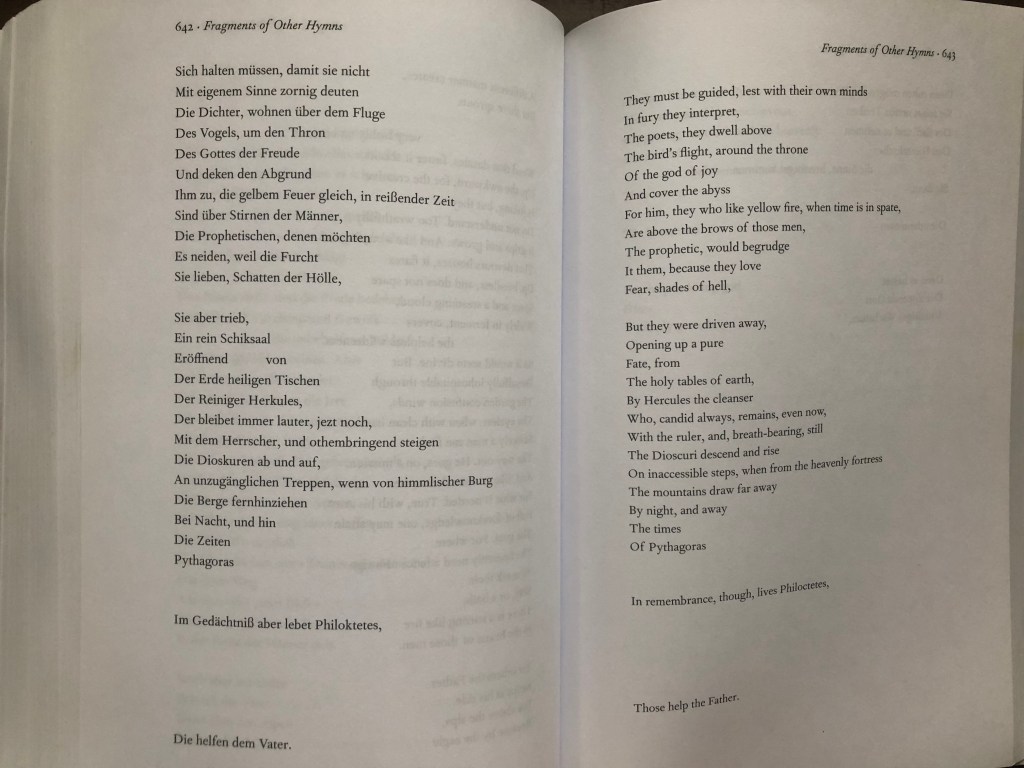

But when the heavenly…
But when the heavenly
Have built, it is quiet
On earth, and well-fashioned stand
The mountains they struck. Their brows
Are marked. For they were hit,
When the straight daughter untenderly
Held back the Thunderer,
By the god’s tremulous ray
And rebellion quenched from above
Exhales a good fragrance.
Where within, assuaged, here
And there, is the fire.
For joy the Thunderer
Pours out and almost would have
Forgotten heaven at that time,
Enraged, if the wise had not
Warned him.
But now it blossoms
In a place of dearth.
And wonderfully great
Desires to stand.
Alpine ranged hang sea,
Warm deep but the breezes cool
Islands and peninsulas,
Grottoes to pray,
A gleaming shield
And quick, like roses,
or else
A different manner creates,
But there sprouts
very lushly an envious
Weed that dazzles, faster it shoots
Up, the awkward, for the creative
Is joking, but they
Do not understand. Too wrathfully
It grips and grows. And like a conflagration
That devours houses, it flares
Up, heedless, and does not spare
Space and a steaming cloud,
Widely in ferment, covers
the helpless wilderness.
So it would seem divine. But
Dreadfully inhospitable through
The garden confusion winds,
The eyeless, when with clean hands
Scarcely a man can find
The way out. He goes, on a mission,
And, like an animal, searches
For what is needed. True, with his arms,
Full of foreknowledge, one may attain
The goal. For where
The heavenly need a fence or a sign
To mark their
Way, or a bath,
There is a stirring like fire
In the hearts of those men.
Yet others the Father
Keeps at his side.
For above the alps,
Because by the eagle
They must be guided, lest with their own minds
In fury they interpret,
The poets, they dwell above
The bird’s flight, around the throne
Of the god of joy
And cover the abyss
For him, they who like yellow fire, when time is in spate,
Are above the brows of those men,
The prophetic, would begrudge
It them, because they love
Fear, shades of hell,
But they were driven away,
Opening up a pure
Fate, from
The holy tables of earth,
By Hercules the cleanser
Who, candid always, remains, even now,
With the ruler, and, breath-bearing, still
The Dioscuri descend and rise
On inaccessible steps, when from the heavenly fortress
The mountains draw far away
By night, and away
The times
Of Pythagoras
In remembrance, though, lives Philoctetes,
Those help the Father.
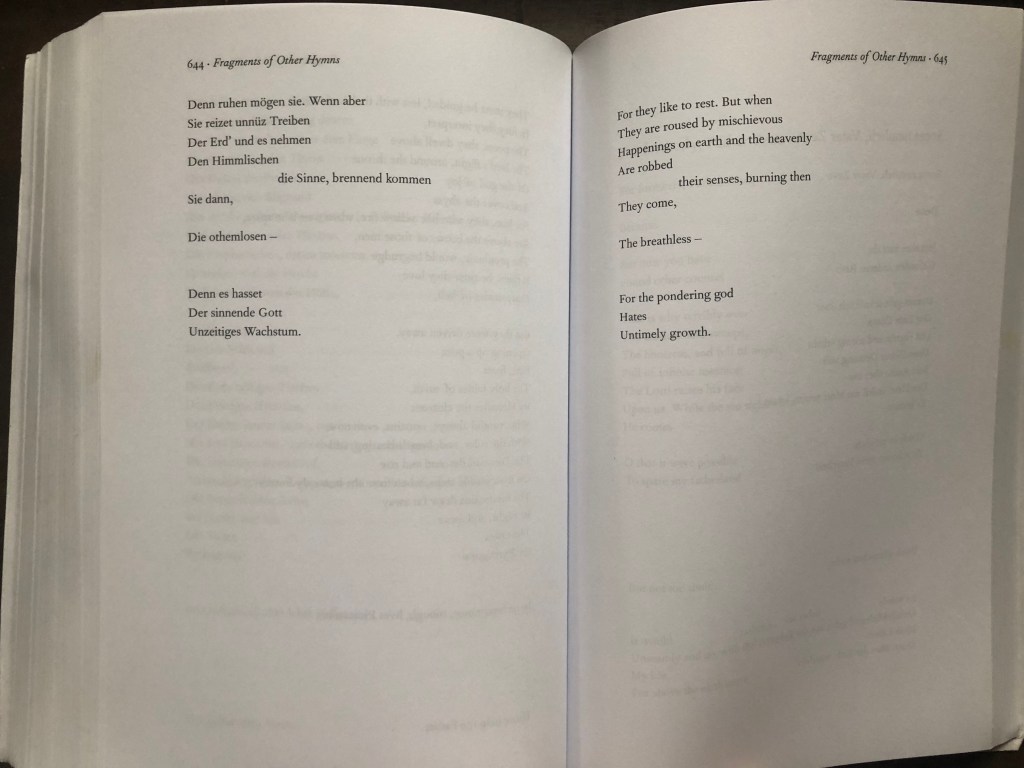
For they like to rest. But when
They are rouses by mischievous
Happenings on earth and the heavenly
Are robbed
their senses, burning then
They come,
The breathless —
For the pondering god
Hates
Untimely growth.




[But when the gods…]
But when the gods have done
Building, silence comes over
The earth, and the mountains
Stand finely shaped, their features
Traced. For as the Thunderer
Contended with his daughter,
They were struck by
The god’s trembling ray,
And fragrance descends
As the uproar wanes.
Where it lies within, soothes, here
And there the fire.
For the Thunderer showers
Forth joy and would have
Almost forgotten heaven
In his wrath, had not
Wisdom given him warning.
But now even poor places
Are in flower.
And will rise
Majestic.
Mountain overhangs lake,
Warm deep but breezes cool
Islands and peninsulas,
Grottos for praying,
A sparkling shield,
And quick, as roses
or else creates
Other ways,
But the sprouting of
rank envious
Weeds, deceptive as they shoot
Up quick and uncouth,
For the Creator has tricks
They do not understand. It grasps
And spreads with too much fury. And like fire
Consuming houses, lashes
Out, uncaring, and spares
No space and covers paths,
Seething everywhere, a smoldering cloud
wilderness without end.
Seeking to pass for something
Godly. But Error reels eyeless
Through the garden, dreadful,
Inhospitable, since no man
With clean hands can
Find exit. He proceeds, driven
Like a beast in search of
Necessities. Though with his arms
And premonitions, a man may reach
The goal. For where
The gods require fences or markers
To indicate their path,
Or need a pool to bathe,
The hearts of men
Beat like fire.
But the Father had others
By his side.
For above the Alps
Where poets must rely
Upon the eagle, lest their angry
Interpretations make mere private sense,
And living above the flight
Of birds, around the throne
Of the Lord of Joy
From whom they conceal
The abyss, these, the prophetic ones,
Lie above the gaze of men
Like yellow fire, in torn
Times, envied by those in love
With fear, the shades of hell,
But they were driven,
A pure fate
Opening from
The sacred tabled of the earth
Hercules the Purifier
Who remains undefiled to this day
With the Lord, and the breath-bearing
Diosuri climb up and down
Inaccesible stairs as the mountains
Retreat from the heavenly fortress
At night, and gone
The times of Pythagoras.
Philoctetes lives in memory.
They go to the Father’s aid
For they desire rest. But when
The useless doings of the earth
Provoke them and from the gods
Are taken
senses, they then come
Burning
These without breath
For thoughtful God
Detests
Untimely growth.
 theslowangel.com
Leave a comment