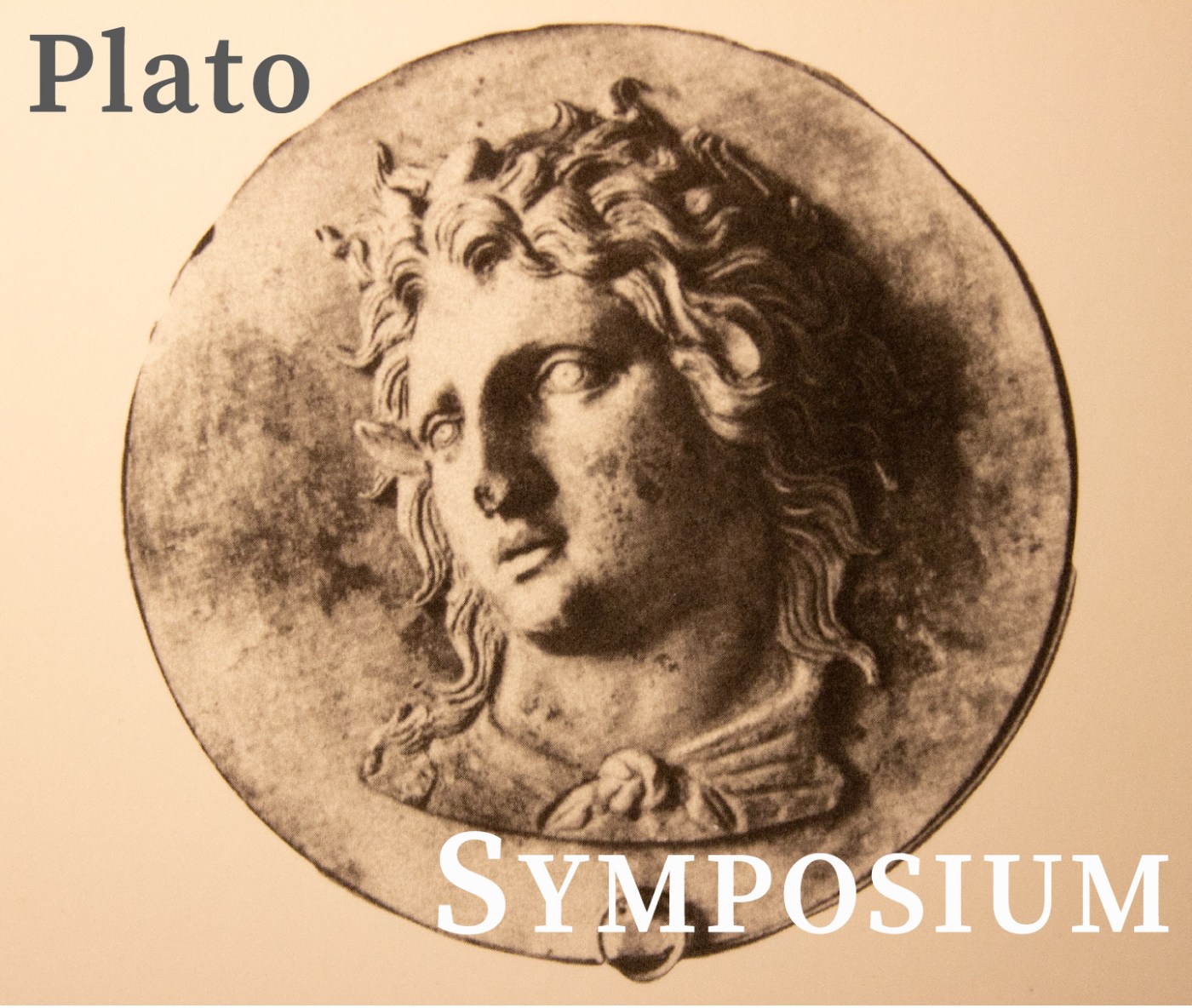
The Speech of Diotima
(this is the end of Socrate’s speech in the Symposium, Socrates is telling the story of a speech Diotima once made to him – Diotima unveils the steps toward the vision of Beauty.)
*
“Even you, Socrates, could probably come to be initiated into these rites of love. But as for the purpose of these rights when they are done correctly — that is the final and highest mystery, and I don’t know if you are capable of it. I myself will tell you,” she said, “and I won’t stint any effort. And you must try to follow if you can.
“A lover who goes about this matter correctly must begin in his youth to devote himself to beautiful bodies. First, if the leader leads aright, he should love one body and beget beautiful ideas there; then he should realize that the beauty of any one body is brother to the beauty of any other and that if he is too pursue beauty of form he’d be very foolish not to think that the beauty of all bodies is one and the same. When he grasps this, he must become a lover of all beautiful bodies, and he must think that this wild gaping after just one body is a small thing and despise it.
“After this he must think that the beauty of people’s souls is more valuable than the beauty of their bodies, so that if someone is decent in his soul, even though he is scarcely blooming in his body, our lover must be content to love and care for him and to seek to give birth to such ideas as will make young men better. The result is that our lover will be forced to gaze at the beauty of activities and laws and to see that all this is akin to itself, with the result that he willl think that the beauty of bodies is a thing of no importance. After customs he must move on to various kinds of knowledge. The result is that he will see the beauty of knowledge and be looking mainly not at beauty in a single example — as a servant would who favored the beauty of a little boy or a man or a single custom (being a slave, of course, he’s low and small-minded) — but the lover is turned to the great sea of beauty, and gazing upon this, he gives birth to many gloriously beautiful ideas and theories, in unstinting love of wisdom, until, having grown and been strengthened there, he catches sight of such knowledge, and it is the knowledge of such beauty…
“Try to pay attention to me,” she said, “as best you can. You see, the man who has been thus far guided in matters of Love, who has beheld beautiful things in the right order and correctly, is coming now to the goal of Loving: all of a sudden he will catch sight of something wonderfully beautiful in its nature; that, Socrates, is the reason for all his earlier labors:
“First, it always is and neither comes to be nor passes away, neither waxes nor wanes. Second, it is not beautiful this way and ugly that way, nor beautiful at one time and ugly at another, nor beautiful in relation to one thing and ugly in relation to another; nor is it beautiful for some people and ugly for others. Nor will the beautiful appear to him in the guise of a face or hands or anything else that belongs to the body. It will not appear to him and one idea or one kind of knowledge. It is not anywhere in another thing, as in an animal, or in earth, or in heaven, or in anything else, but itself by itself with itself, it is always one in form; and all the other beautiful things share in that, in such a way that when those others come to be or pass away, this does not become the least bit smaller or greater nor suffer any change. So when someone rises by these stages, through loving boys correctly, and begins to see this beauty, he has almost grasped his goal. This is what it is to go aright, or be led by another, into the mystery of Love: one goes always upwards for the sake of this Beauty, starting out from beautiful things and using them like rising stairs: from one body to two and from two to all beautiful bodies, then from beautiful bodies to beautiful customs, and from customs to learning beautiful things, and from these lessons he arrives in the end at this lesson, which is learning of this very Beauty, so that in the end he comes to know just what is it to be beautiful.
“And there in life, Socrates, my friend,” said the woman from Mantinea, “there if anywhere should a person live his life, beholding that Beauty. If you once see that, it won’t occur to you to measure beauty by gold or clothing or beautiful boys and youths — who, if you see them now, strike you out of your senses, and make you, you and many others, eager to be with the boys you love and look at them forever, if there were any way to do that, forgetting food and drink, everything but looking at them and being with them. But how would it be, in our view,” she said, “if someone got to see the Beautiful itself, absolute, pure, unmixed, not polluted by human flesh or colors or any other great nonsense of mortality, but if he could see the divine Beauty itself in its one form? Do you think it would be a poor life for a human being to look there and to behold it by that which he ought, and be with it? Or haven’t you remembered,” she said, “that in that life alone, when he looks at Beauty in the only way that Beauty can be seen — only then will it become possible for him to give birth not to images of virtue (because he’s in touch with no images), but to true virtue (because he is in touch with the true Beauty). The love of the gods belongs to anyone who has given birth to true virtue and nourishes it, and if any human being could become immortal, it would be he.”
This, Phaedrus and the rest of you, was what Diotima told me. I was persuaded. And once persuaded, I try to persuade others too that human nature can find no better workmate for acquiring this than Love. That’s why I say that every man must honor Love, why I honor the rites of Love myself and practice them with special diligence, and why I commend them to others. Now and always I praise the power and courage of Love so far as I am able. Consider this speech, then, Phaedrus, if you wish, a speech in praise of Love. Or is not, call it whatever and however you please to call it.
(pgs. 58-60)
*
 theslowangel.com
Leave a comment