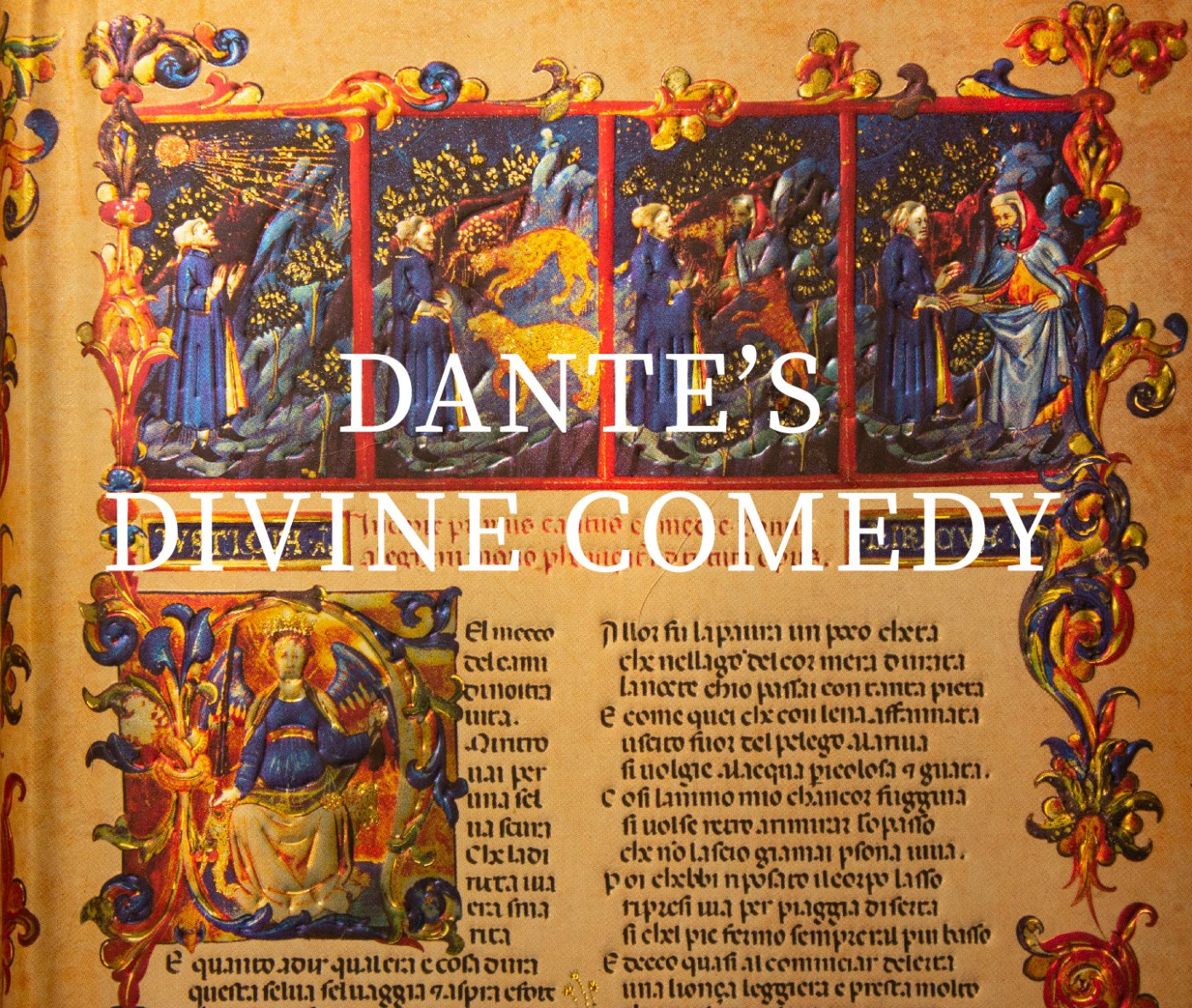
I read Dante’s Divine Comedy during the days of Lent earlier this year. On the day I finished reading I jotted some notes while thoughts and reflections were fresh. Below I’m going to type up the notes I made several months ago, in early April:
*
I finished reading Dante’s Divine Comedy today. The ascent into Heaven was completely dazzling and dizzying. One reading is not enough to absorb all that the work has to offer, I’m considering this first full reading just a primer, and plan to return to take the journey several more times as my own life unfolds. This work is poetically stunning and astonishing in its scope and vision. To follow are a few thoughts I’ve had along the journey, concepts and lines of sight that have come into clarity during the descent & ascent.
I. Hell is immobility, God is motion
At the center of Hell is a frozen lake, where Satan resides in the ice. Satan has multiple faces and is consuming the bodies of sinners. Hell is fixity, immobility and the inability to change. We are moved only by God, the prime mover, the unmoved mover. We are brought to immobility as we use our free will to stray from God and depart from God’s will for us. Pride is our attachment to our own will. To think that we can apply our own will and become productive with our own aims without the will of God is our greatest folly. And yet free will also guards the threshold of consent – free will is required and necessary component of our alignment with God’s Will. Free will also allows us to correct course when we have gone astray.
Our task is to bring our will into synchronous alignment with the will of God and to achieve motion toward Him. In Heaven things are always in motion – filled with turning wheels, golden wheels, rows of angels and rays of light, the eternal fountain, things flowing and singing…Everything moves by Love. Free will is our ability to align our own free wills to the will of God as we learn to pursue and desire Beatific vision.
II. Desire
In Dante one cannot have too much desire, the only problem is when one directs one’s desire at the wrong thing. To direct one’s desire at anything other than Love of God will lead one astray. In Hell we see all the variations of misplaced desire – greed and the desire for fame and esteem, the desire for food that is gluttony, lust and promiscuity, pride to be the best, opportunists, desire for power that leads to corruption, the liars and betrayers of truth, the fence-sitters, the lukewarm. In Purgatory, souls learn to not only stop the actions that brought them to ruin, but more importantly, they learn to stop desiring to enact their own ruin. The passage to the sinful act is what weighs in our judgment and brings ruin but the desire is where the transition takes place for the soul. Desire should be aimed at God. This is what the souls learn in purgatory; to repent and express remorse for their past ways of being and to learn to desire God. When we shift our desire to be aimed at God those things we were attracted to previously stop being desirous. The problem is never too much desire, just misdirected desire.
This mode of thinking is a departure from Dante’s guide, Virgil, who was an advocate of reason and duty above all. For Virgil to be too passionate would be a mistake, but for Dante too much passion is never a problem, and passion and desire actually become completely necessary in the motions of ascension.
III. Instinct & Intellect
There is an instinct in our innocence that moves us toward God, & yet the free will reserves the power to turn away. Part of the influence that is upon us comes from the stars and celestial influences. It is our innocence that is moved by these forces. Our instincts and intuition can help us align with the forces of divine influence when we are not too prideful in our attachment to our own wills. We should not use our intellects to outdo and outsmart the influences of our innocent conscience and instinct toward God, but rather we should use our intellect to align with our innocence and instinct toward God, to hold open the space for Grace and God’s Love that moves us.
IV. The Universal & Particular, The Singular & the Multiple
We each live out the universal through our own particular story. Dante achieves the unification of the universal and particular on many levels within the journey – there is the particular story of Dante on a universal quest for Beatific Vision, we meet the particular characters of Florence in their universal rings of hell and purgatory and heaven, the use of Virgil as the guide includes the history of Italy and Italian poetry into the universal model of the afterlife, we join the pre-Christian mythology of the Greeks with the teachings of Christian theology and unite them with the stages of divine ascension – all of this is brought together in a vast cosmic universal model of the concentric rings and knots of hell/purgatory/heaven in which there are descending and ascending orders of being & Being.
In Heaven Dante offers many visions of how the one becomes unified with the multiple. We consider the leaves of an infinite tree, each leaf as its own and inseparable from the tree. “All things are unified in the field by what joins them.” We see the shards of a shattered mirror reflecting the source of all light. Earlier, Beatrice does a demonstration with three mirrors and places the three mirrors at different distances and then shines one light and asks Dante to observe how the light is equally bright in each mirror no matter the distance from the source. This is a parable for God, the source of all light.
V. Canto 19 (Heaven)
“Thus our vision is but one ray of the Mind that fills all things, and it is not for us to blink the fact that our sights origin lies far beyond the furthest we can see, and so the power of eyesight working in your world may pierce the sheer infinity of Everlasting Justice only as the eye into the sea, whose bottom shows near shore, but in the open deep it has no bottom seen, though the mind knows depth has concealed the truth. All light comes from clear unclouded sky. Else, darkness reigns, the shadow of the flesh, which is the sum of all its sensual errors and dark stains.”
Dante
 theslowangel.com
Leave a comment