*
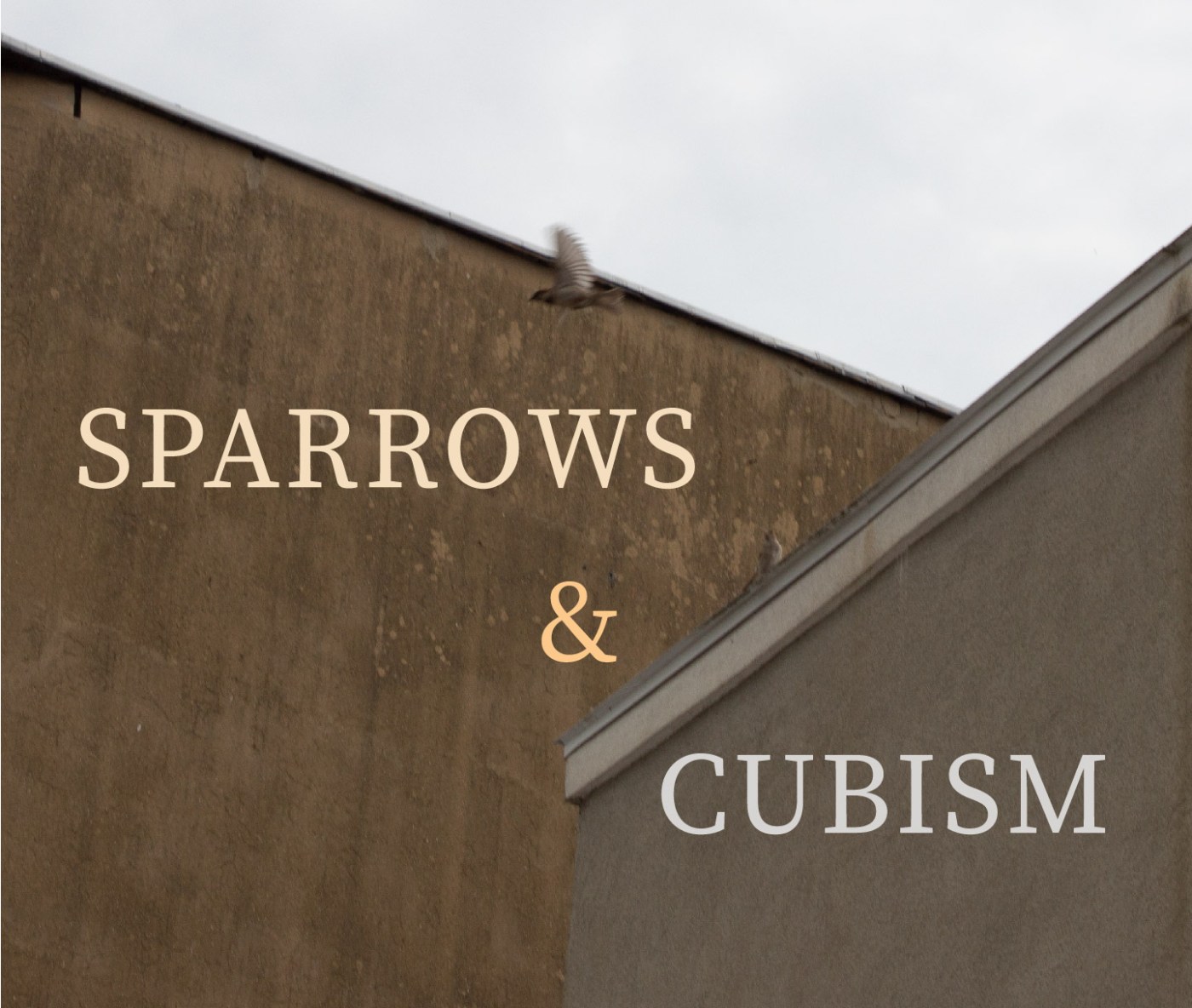
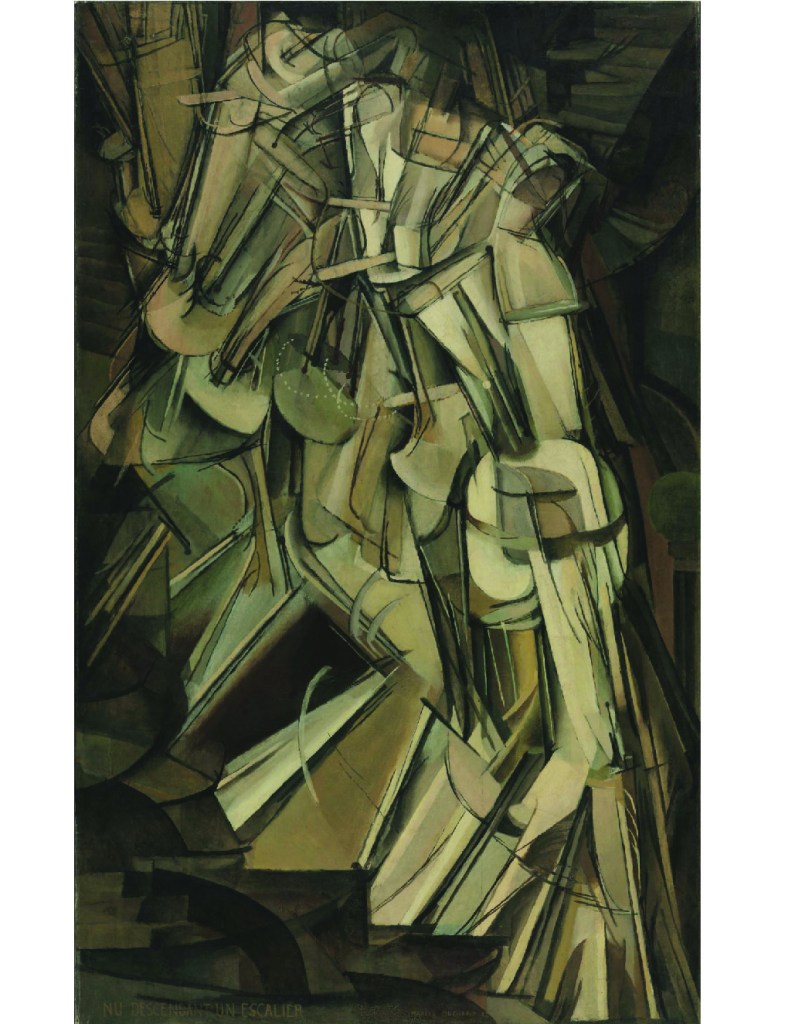
I’ve been painting blurry birds in flight lately. The images of the birds occupy a space of motion rather than fixed form, somewhere in between form & formlessness. Considering this liminal space of perception brought my mind to cubism, where objects are viewed from multiple perspectives at once. Bodies are fragmented before becoming reassembled geometrically. In the case of Duchamp’s Nude Descending a Staircase we see a form in motion like a visible fugue of overlapping space-time. Because my mind is in the middle air with the sparrows, I opened up the book “The Genius of Birds” the other day and scanned the index for mention of sparrows. This brought me to a chapter about an experiment conducted to determine if birds had aesthetic sensibility and discretion. In Japan they released a group of sparrows in a recreated museum and observed them as they continually gathered before cubist works. It occurred to me that many birds like sparrows, starlings, and mourning doves are often in groups, and occupy a shared mind in which the world is perceived from a multiplicity of viewpoints simultaneously. I’m wondering how this can be depicted in a painting, whether or not a flight or murmuration of birds can be depicted in a space of cubist multiplicity perception. All of this feels like just an elementary step toward the contemplation on the vision of God, the one seeing from everywhere at once from beyond the veil.
*
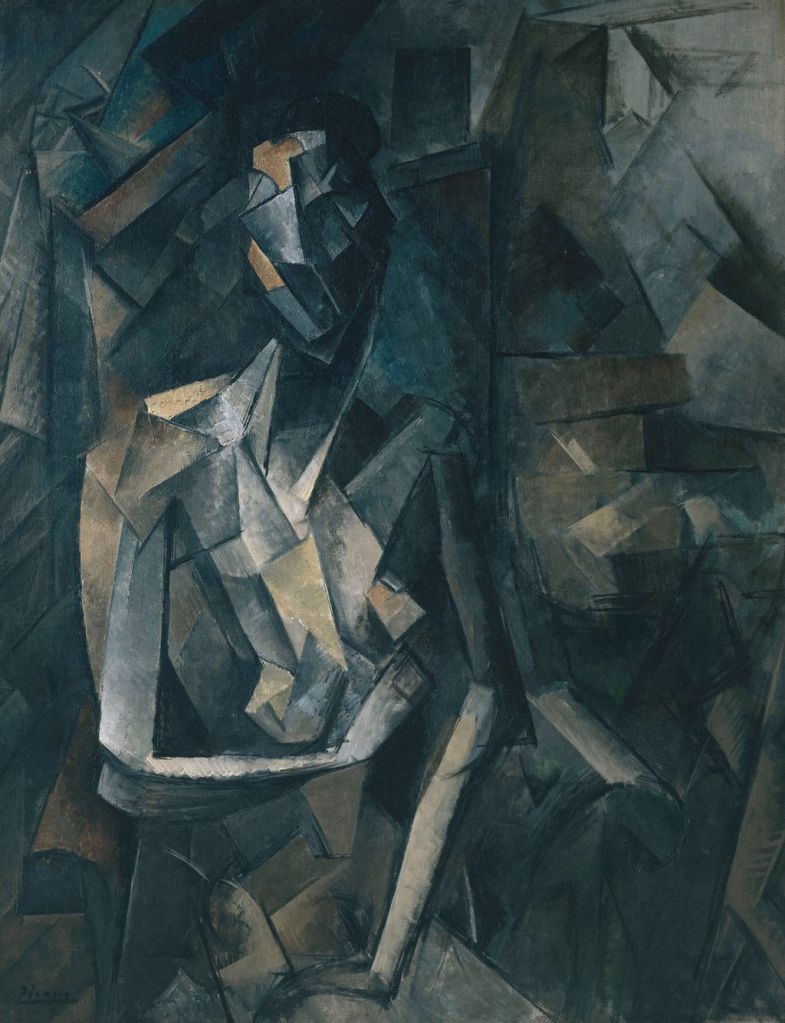

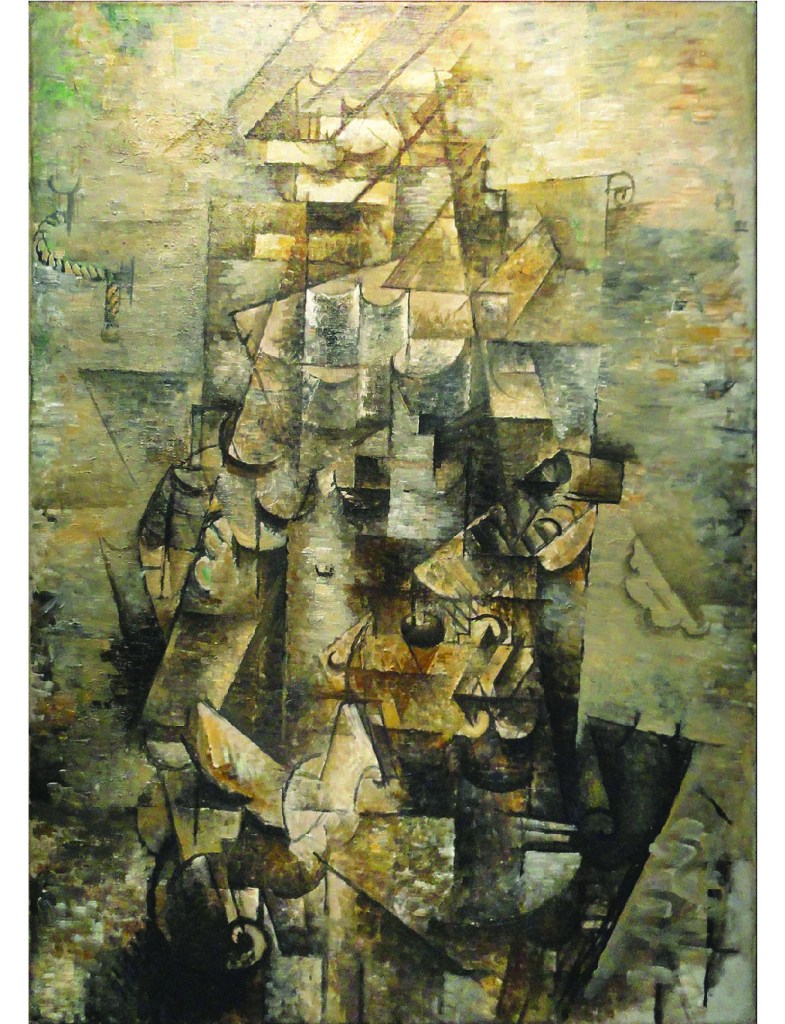

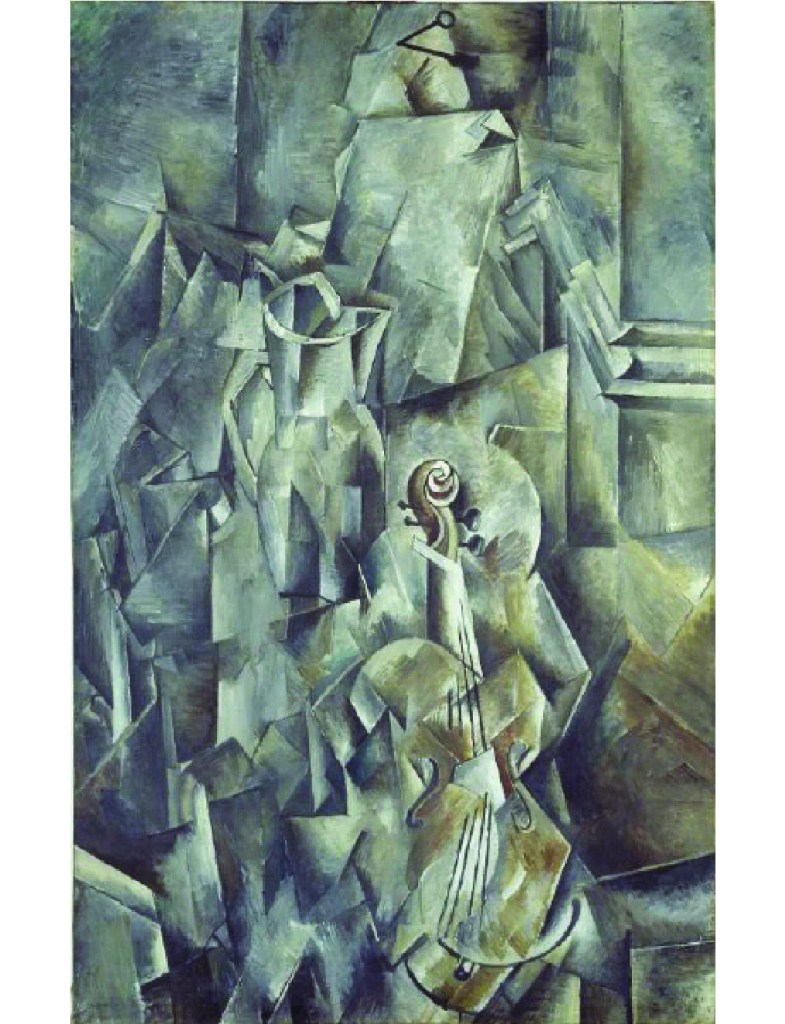
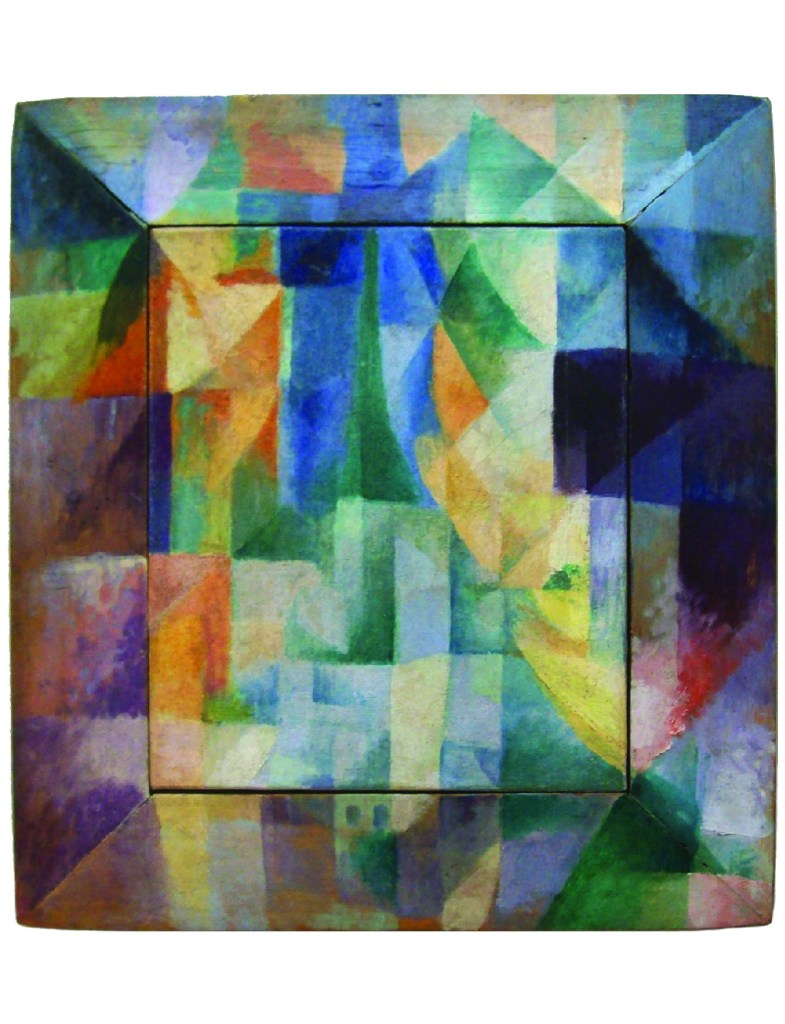
1. Pablo Picasso, Seated Nude, 1909-1910
2. Marcel Duchamp, Nude Descending a Staircase,1912
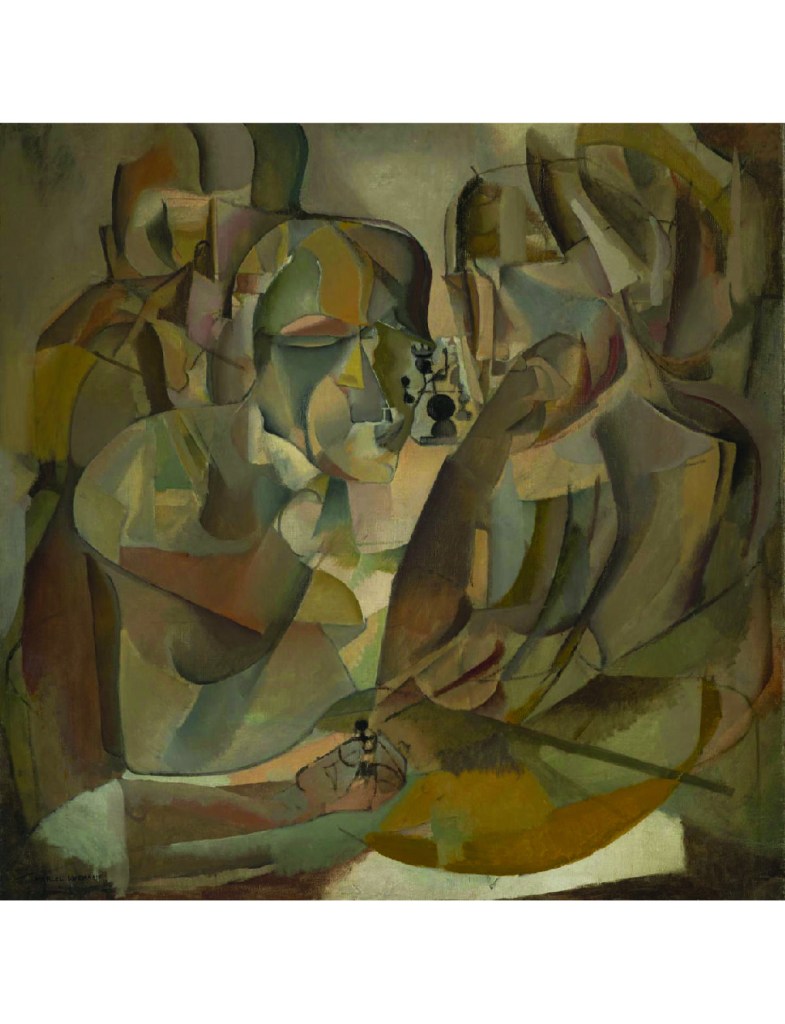
3. Marcel Duchamp, Portrait of Chess Players, 1911
4. Pablo Picasso, Girl with a Mandolin, 1910
5. Georges Braque, Man with a Guitar, 1911-1912
6. Georges Braque, Woman with a Guitar, 1913
7. Georges Braque, Pitcher and Violin, 1909-1910
8. Robert Delaunay, Simultaneous Windows on the City, 1912
*
“…do birds prefer any particular style of painting? To find out, Wantanabe’s team created a rectangular birdcage designed to resemble a hallway in an art gallery. Along the “hallway” were stationed screens showing different painting styles: traditional Japanese style paintings by Ukioy-e, as well as impressionist and cubist paintings. The scientists timed how long the birds perched before each kind of painting. This time the art critics were seven Java sparrows. Five of the seven appeared to favor cubism over Impressionism; six of the seven showed no clear favorite between the Japanese and impressionist paintings (perhaps a disappointment to the Japanese investigators). Still, this was the first study attempting to show that animals other than humans may have preferences in human paintings.
More recently, research has shown that distinguishing painting styles – using color, brushstroke, and other clues – is not at all unique to humans. Indeed, scientists have trained honeybees to tell a Picasso from a Monet.
This is easy stuff to poke fun at. The idea that birds and bees play favorites with human art looks a lot like anthropomorphism. But Watanabe’s work is less about whether birds prefer Braque to Monet than it is about their powers of acute observation and discrimination of color, pattern, and detail.
Birds are visual creatures. They make quick decisions based on visual information from heights at great speed. Pigeons shown a series of landscape photographs taken successively can detect slight visual differences that are hard for humans to pick out. They can also recognize other pigeons by sight alone. So can chickens. Just because the powerful little central nervous systems of pigeons or bowerbirds are organized very differently from our own doesn’t mean they’re less capable of exceptional visual perception and fine discriminations.”
Jennifer Ackerman, The Genius of Birds, pg. 190
*
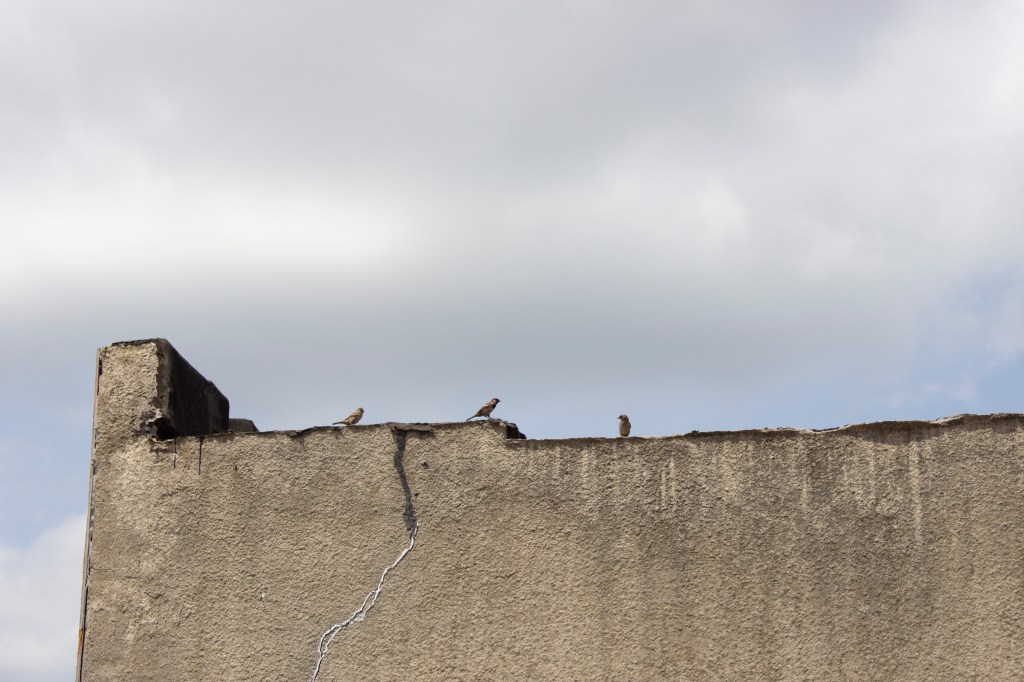
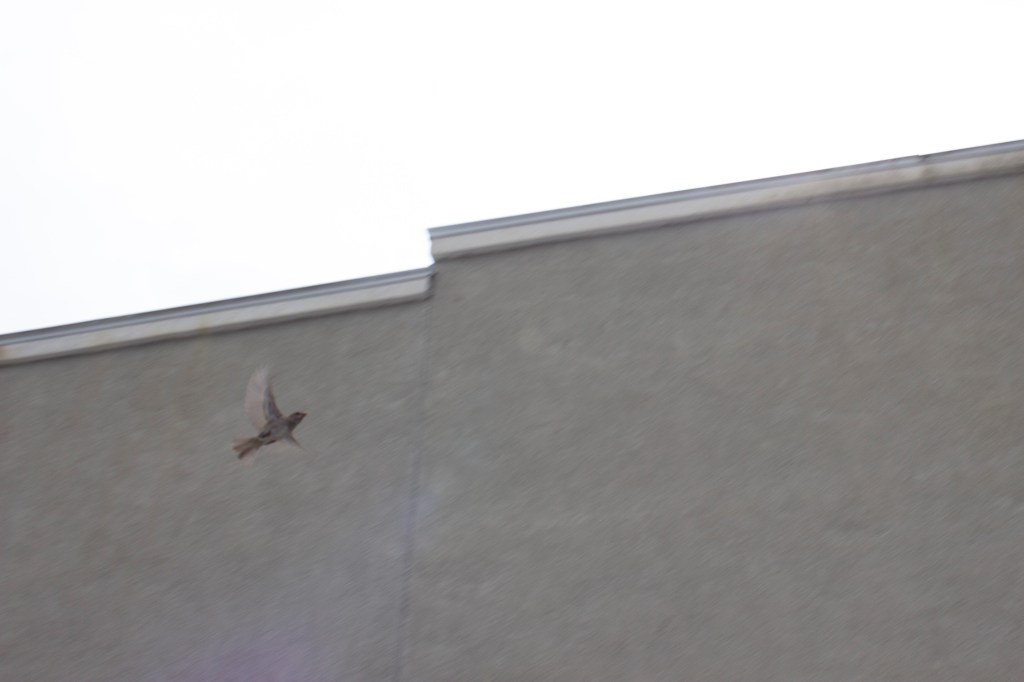
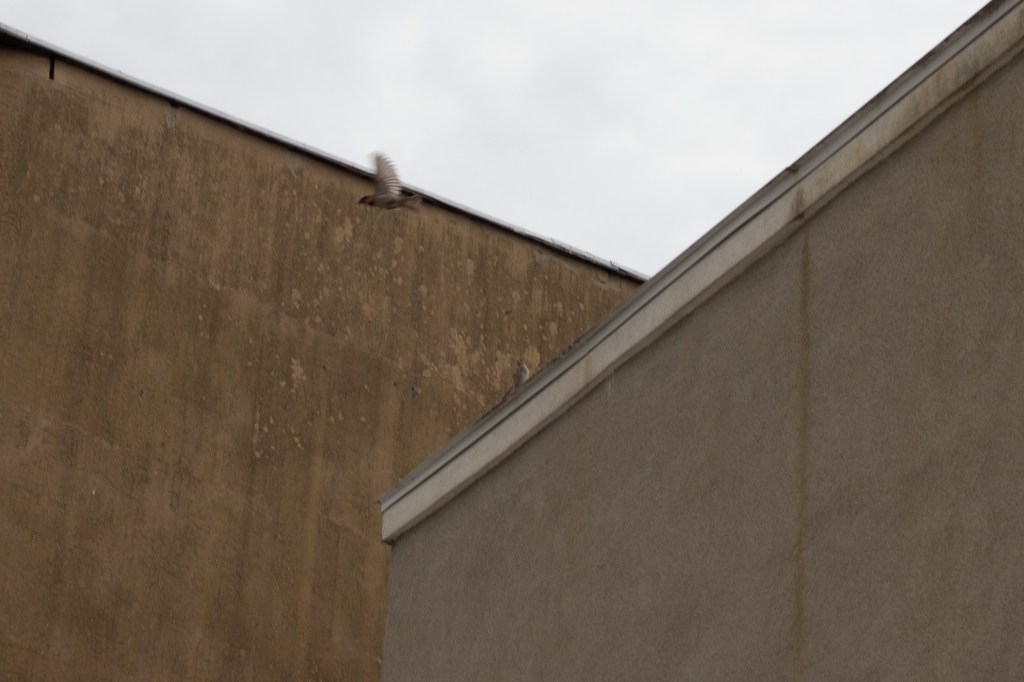
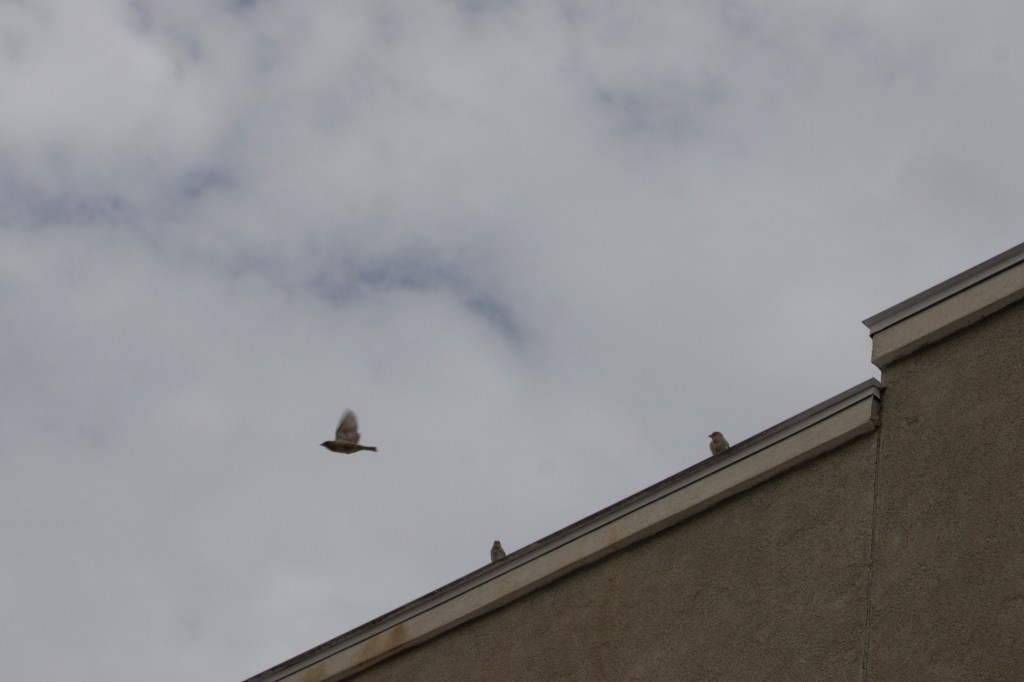
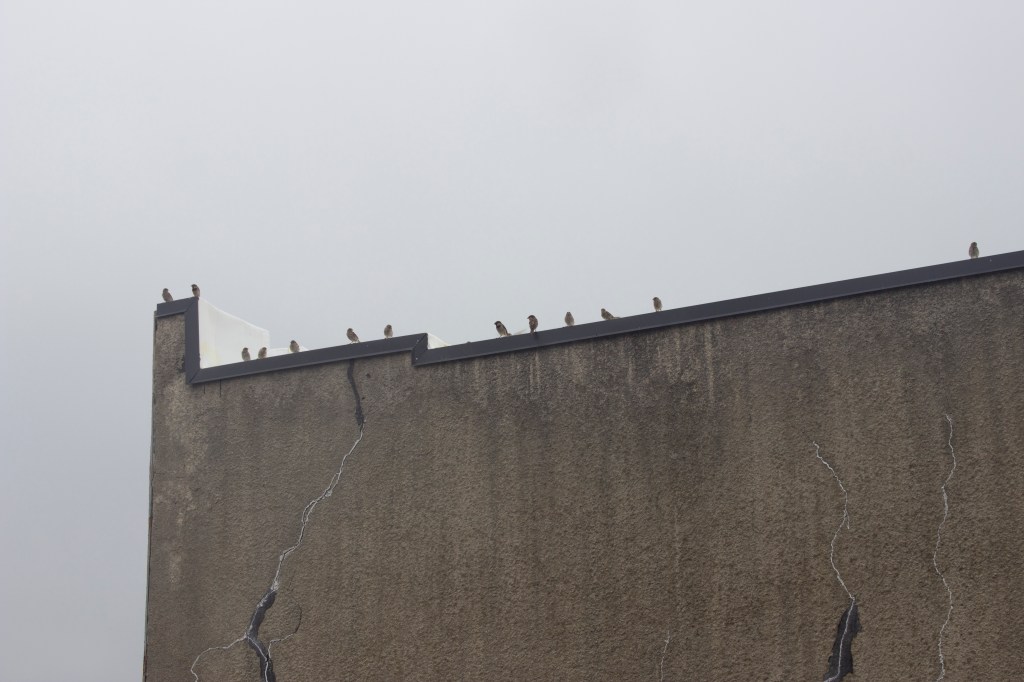
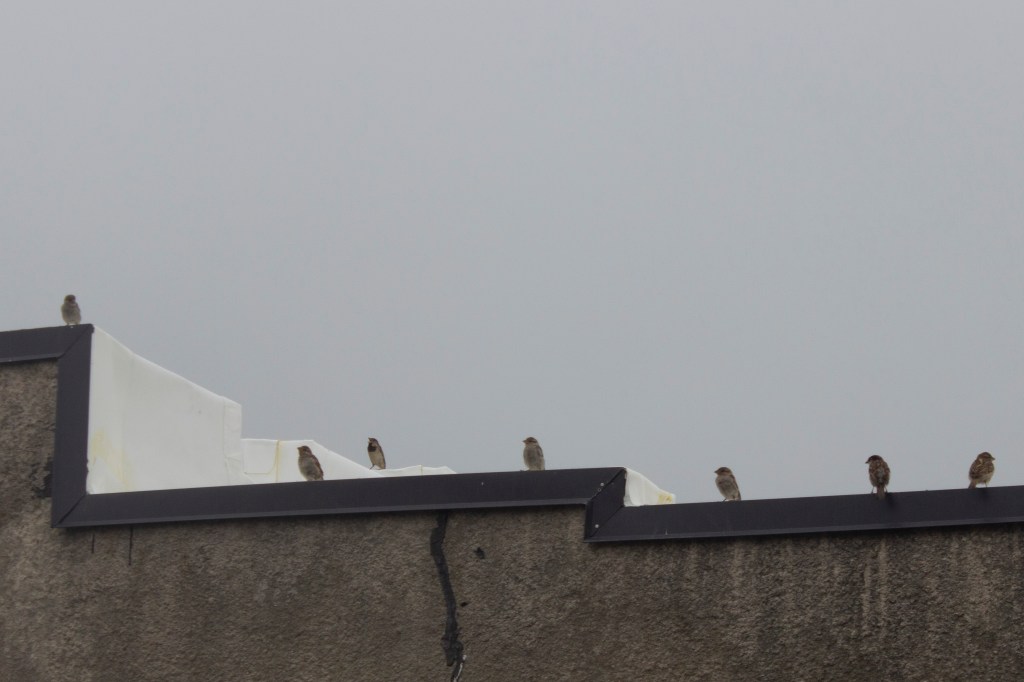
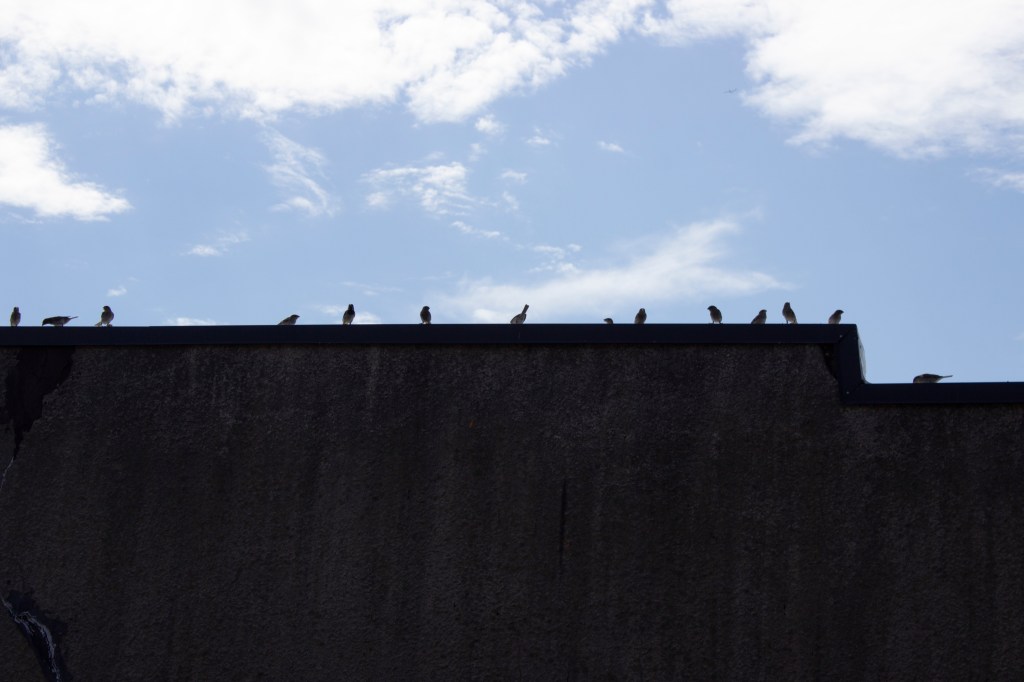
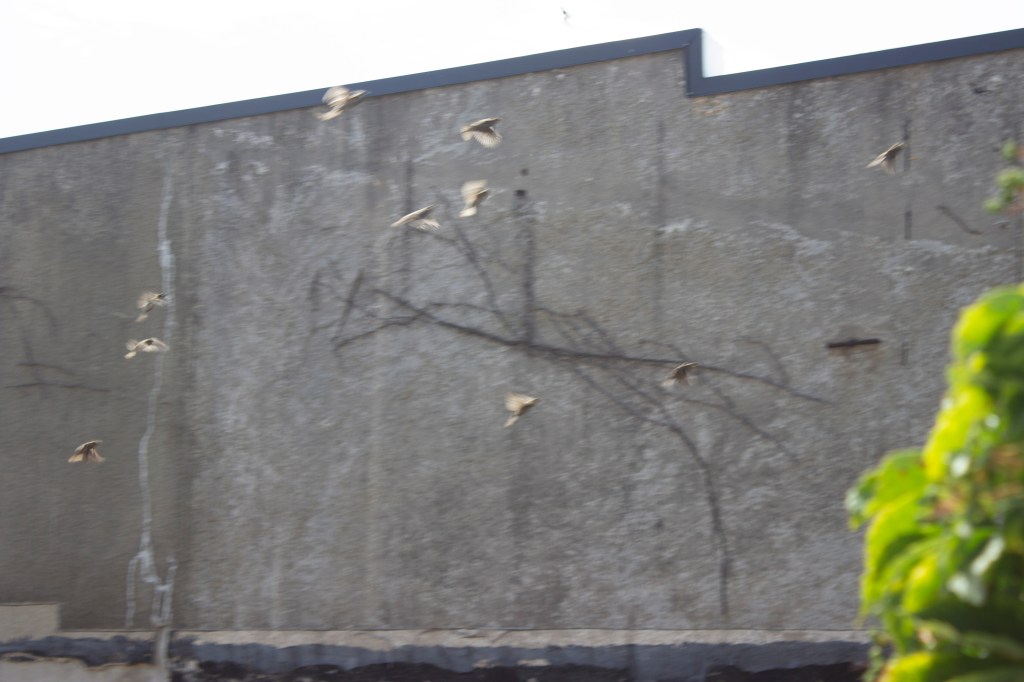
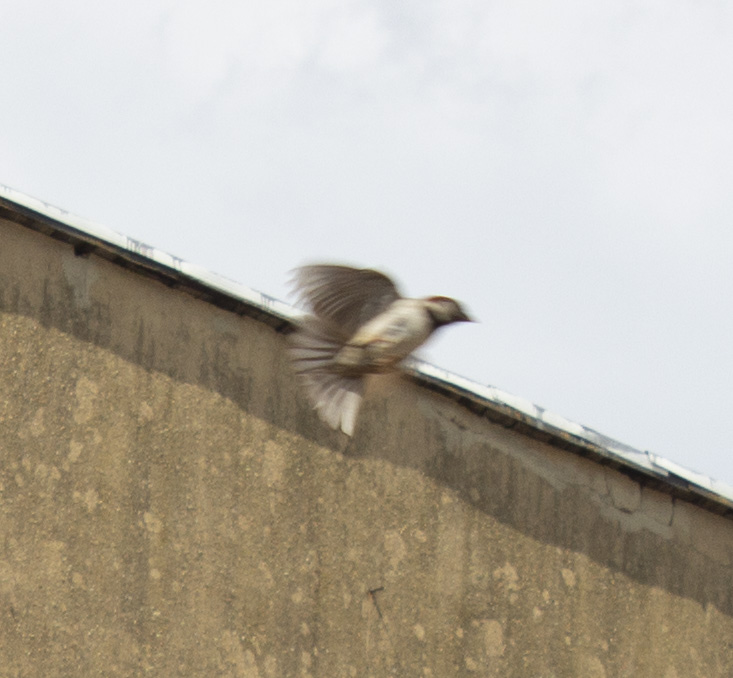
I feed the birds on the roof of an ice cream parlor and each morning I climb up the building and renew the food, I bring my camera and try to photograph the sparrows, mourning doves, pigeons and crows as they encircle the roof top and land, perch watching and take flight. As I try to photograph them I end up capturing fragments of buildings and airspace, blurry birds, or those that have perched on the edges. In repetition, day after day, I’m beginning to learn to inhabit the perceptual space of the frame in which architecture becomes fragmented and blurry as one’s vision enters the speed of the flight of sparrows through angles of light. The edges of the buildings demarcate the perch spaces and fly-zones of the sparrows, and also resemble some of the geometric angles used in the cubist paintings.
*


*
I’m interested in the artistic gesture to occupy Beauty as it might be perceived by the sparrows. A first step would be to recognize that beauty exists without the human eye, that beauty was here before us & will remain after us – there is beauty in uninhabitable regions. Rather than seeing the sparrows in an anthropomorphic, human-centered way, I’m interested in an art that attempts to occupy the perceptual world of the sparrow, linked to the human by way of pure consciousness – we occupy a shared field of repeating pattern in our difference. The poet Robinson Jeffers throughout his career developed a poetics of “inhumanism”, which is in many ways an attempt to recognize beauty dislocated from human centered perception. In the poem Credo he writes, “The beauty of things was born before eyes and sufficient to itself; the heart-breaking beauty will remain when there is no heart to break for it.” Perhaps it is worth considering that the sparrows, the cypresses, and the stones will have extension into a greater reach of time than the human being’s limits of habitation.
*
“It doesn’t storm for a sparrow’s death”
from Cawdor, Robinson Jeffers
*
29 Are not two sparrows sold for a farthing? and one of them shall not fall on the ground without your Father.
30 But the very hairs of your head are all numbered.
31 Fear ye not therefore, ye are of more value than many sparrows.
Matthew 10:29-31 KJV
*
Despite the desire to occupy the perceptual space of the sparrow, Art is an offering to human beings, not the birds. The desire is more truly to expand and lift the capacity of human perception. Is it possible to make a gesture that points in multiple directions at once? When Saint Francis preached to the birds I believe he was sincerely preaching to the birds, his voice, his perception was being given to the birds in the moment in which he spoke. And yet the story of Saint Francis preaching to the birds is now a story for human beings. Perhaps this is what art is, the difference between the act of creation and the material residue of the creative act – the painting itself. Perhaps the painting is the material residue of an inhuman occupation, however temporary and fleeting that might be – flashes of wings in the middle air, singular minds glimmering in a wind of multiplicity. Saint Francis preaching to the birds observed by a multitude of angels.
*
I’ve painted the first study of the Sparrows in the Middle Air, the painting style is very pared down and vulnerable, letting the brush strokes be what they are. I plan to extend this study into many more works and unfold the inspiration.

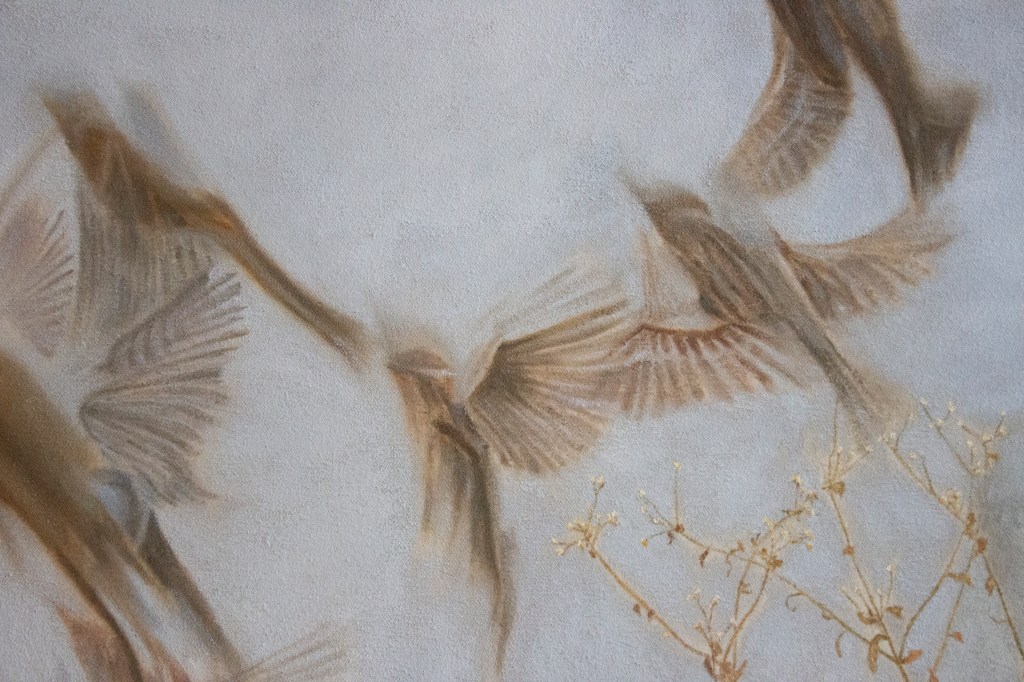

Sparrows in the Middle Air (study)
26″ x 16″
Oil paint on Canvas
July 2022
*
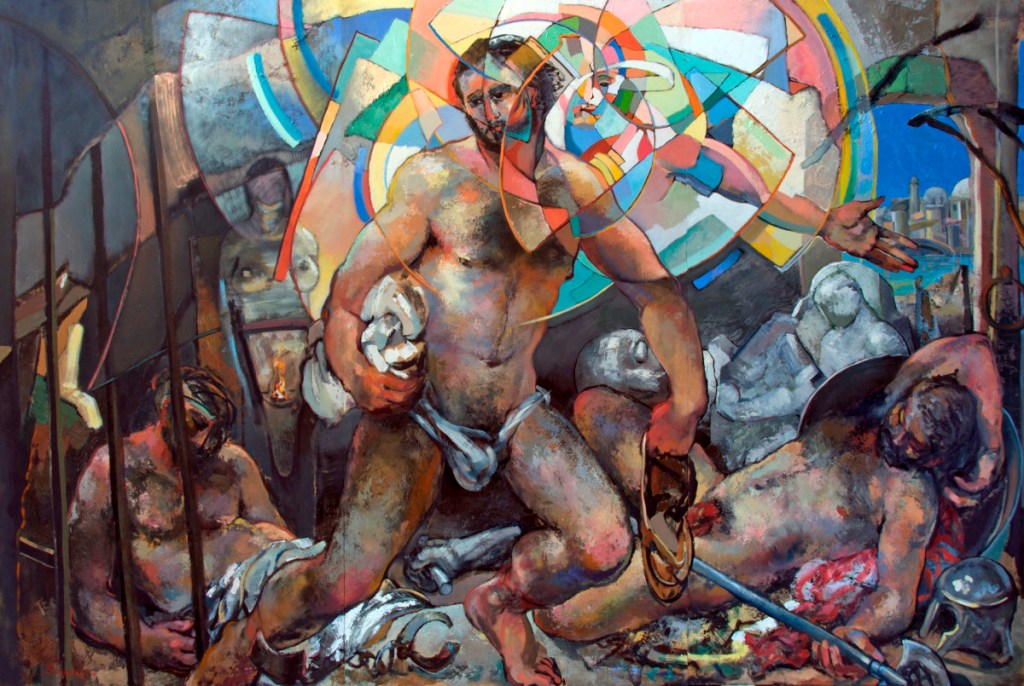
While listening recently to the podcast “Naming the Animals” by Stephen Roach, episode 07 “Glorification” featured an artist named Edward Knippers. In the conversation the artist and podcasters are reckoning with the question of how human art might glorify God. At a certain point in the conversation the artist begins speaking about his
“I’m called to make art, God has to let me know how to glorify Him. A good example I think would be when my wife died, I started using the metaphor of Cubism to show the movement of the veil and behind the veil. Because in cubism it’s never set, it’s always in motion, so there’s another kind of reality that you’re dealing with other than our earthly reality and I was combining the two. In this process I found I had actually done something like that very early in my work when I had done a while series called Intrusions when I was using abstract expressionism as a metaphor. I was with a group and friends with people at Princeton. There were two Russian scholars there…they were turning the whole icon upside down and reevaluating it…what they found was that in the icons there were buildings that were drawn and people thought they were just poor drawing, they just didn’t know how to do it. They reevaluated it and showed that the buildings were being seen from different points of view at the same time. In other words, it was Cubism. And it was only in heavenly buildings that were not meant to be built. In other words, they were using the same metaphor for heavenly places that I was in my work. And I mentioned what I was doing very briefly and they were ecstatic. In fact, during the lecture, one scholar dealt with the veil, and he came to me after and said, the veil was for you. But you see god had directed me to come to an understanding that was 1,000 years old, and I had no idea, but he brought me to that point and that is exactly what he does.”
Edward Knippers on Naming the Animals Podcast episode 07
*
*
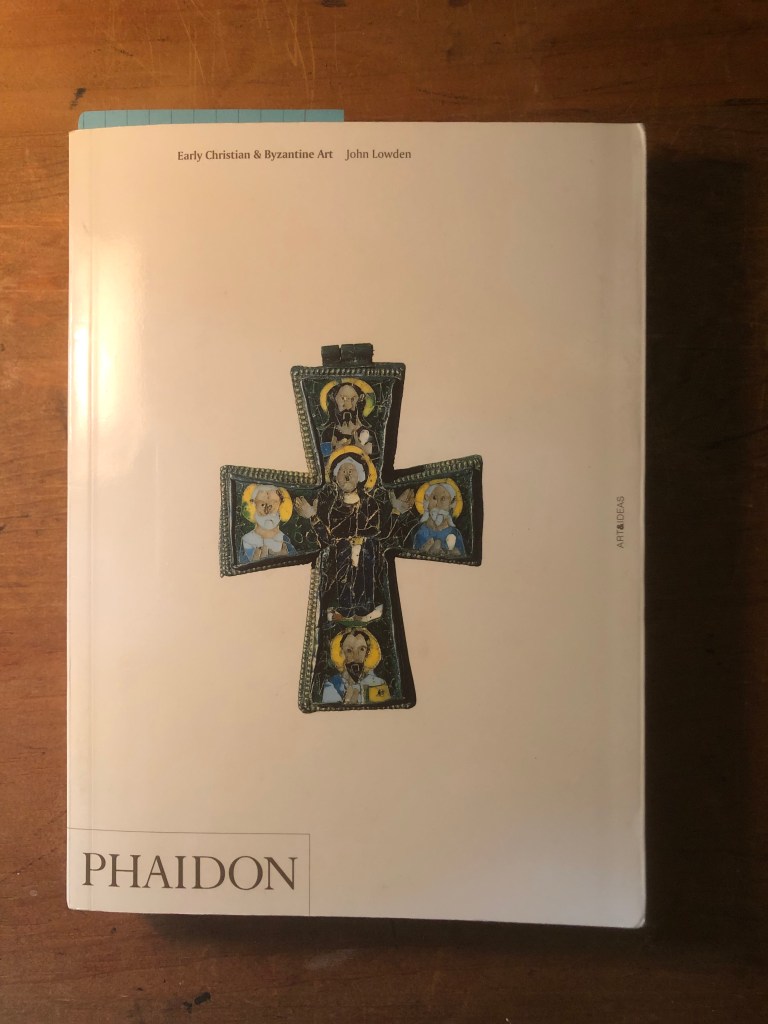
I need to research more Christian Orthodox painting to discover more about what the Russian scholars were talking about at Princeton. Today I am home reading Early Christian & Byzantine Art by John Lowden, published by Phaidon. I am currently awaiting more stretcher bars to make canvases for more sparrow paintings. In the meantime I am fasting, studying, and preparing my vision.
*
*
*
 theslowangel.com
Leave a comment