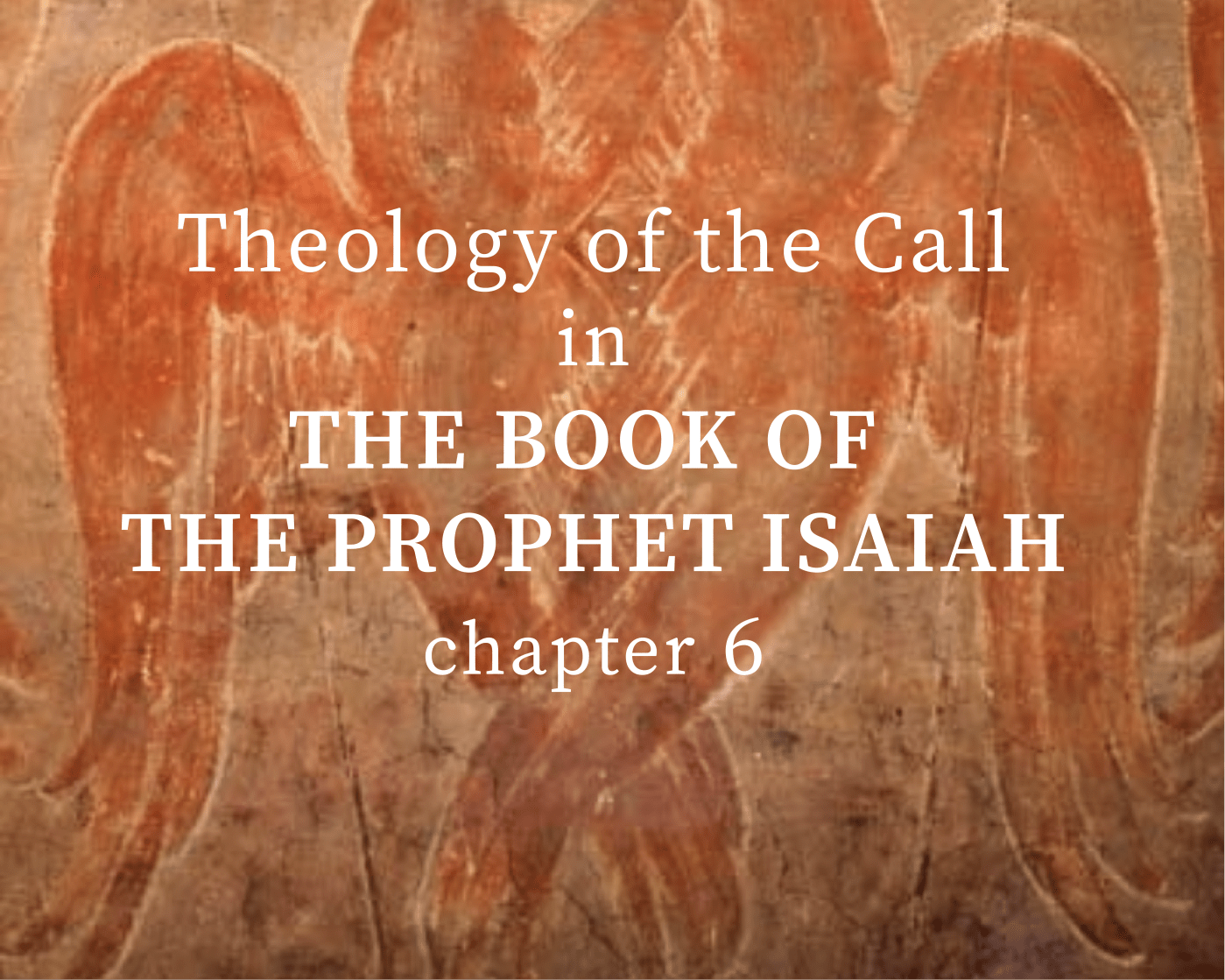
Theology of the Call
in
THE BOOK OF THE PROPHET ISAIAH
chapter 6
*
A moment arrives, as God wills it, whereby one is called to recognize the presence of Truth. In responding to the call, one feels one’s own inadequacy and understands our complete dependence upon God. In the book of the prophet Isaiah, he receives a vision of the Lord in chapter 6:
1 In the year that king Uzziah died I saw also the Lord sitting upon a throne, high and lifted up, and his train filled the temple. 2 Above it stood the seraphims: each one had six wings; with twain he covered his face, and with twain he covered his feet, and with twain he did fly. 3 And one cried unto another, and said, Holy, holy, holy, is the LORD of hosts: the whole earth is full of his glory. 4 And the posts of the door moved at the voice of him that cried, and the house was filled with smoke. 5 Then said I, Woe is me! for I am undone; because I am a man of unclean lips, and I dwell in the midst of a people of unclean lips: for mine eyes have seen the King, the LORD of hosts. 6 Then flew one of the seraphims unto me, having a live coal in his hand, which he had taken with the tongs from off the altar: 7 And he laid it upon my mouth, and said, Lo, this hath touched thy lips; and thine iniquity is taken away, and thy sin purged.
When Isaiah receives the vision of the Lord, he cries out, Woe is me! He must confront his own sinfulness, the unclean lips from which he has spoken and the life he has lived within the midst of corrupt people. He is terrified and expects his own immediate destruction, and then the seraphim fly to him. The seraphim prepare Isaiah for service to God by placing a burning coal from the altar of the offerings on his lips. Nothing but God and his holy angels can prepare one for service. While Isaiah was a man of learning and of royal bloodline, all of this is rendered inadequate and obsolete once there is a vision of God and a true call. No learning, no school, no status in society or personal achievements can prepare one for service. When one hears the call one must simply offer oneself in complete humility. All unfolds according to God’s timing. It will be God’s work and the work of His holy angels that prepare one for service, God alone can cleanse our pollution, wherever it exists.
After we hear the call we must humble ourselves before God. In The Steps of Humility written by Saint Bernard of Clairvaux he writes that in order to begin on the spiritual path one must consent to eating “the bread of sorrow” and drinking “the wine of remorse”. Consenting to eat the bread of sorrow means to become willing to recognize that one is complicit in a fallen and sinful world. Drinking the wine of remorse means to confront one’s own sinfulness and to repent with remorse. It is God & the Holy Spirit that will purify the one who is called, one must first humble oneself, and then consent to the acts of purgation and purification.
Purging & forgiveness of sins is the step that follows after we become humbled. One must consent to the acts of purging. We should understand the placing of the coal on Isaiah’s lips as happening symbolically in a spiritual vision. If we apply the principle of purgation and purification to our own lives in response to our own recognition of the higher truths of the divine, our time of purgation and purification might be many weeks, months, or years.
We can learn from the appearance of the seraphim a model of how one is to compose oneself during our time of purgation. With two wings they cover their eyes, this is to symbolize their humility before the absolute holiness of God; even the angels cannot endure God’s brightness, we must remain sober and modest in our capacity. With two wings they cover their feet, this is to symbolize that they wish not to touch the ground of the corrupted earth and thereby tarnish their angelic nature; we must learn likewise how to “be in the world but not of it” . And with two wings they fly, this is to symbolize the plane on which one should keep one’s awareness — above the corruption of the world and beneath the absolute holiness of God, in humility beneath the most high, and in exaltation and praise above corruption and deceit.
The seraphim are among the highest ranking angels, the word seraphim means “aglow with red hot heat” or the “burning ones”. They are the angels that fly endless circles around God. They cry out “Holy, holy, holy, is the LORD of hosts: the whole earth is full of his glory.” The repetition of “holy” is the seraphim calling out to each other like birds. Their vision of the earth as “full of his glory” is instructional to us. We learn that even in a fallen world full of corruption and filth the eyes of seraphim still see the glory of the Lord. We must learn to perceive with this chastity of vision, to see the spirit of the Lord in all things.
The vision concludes as the house is filled with smoke. The smoke is also a symbol for us to reflect on, and here I will turn to the instruction of John Calvin, who writes, “it was always the will of God to repress people’s insolence in pushing their inquiries about his majesty beyond what is proper. For on this point almost everyone is too rash and daring. They want to rise above the clouds and penetrate God’d secrets, while they do not see what lies at their feet. God has good reason to use smoke — to remind people of their weakness. He forbids us to inquire or search beyond what he has revealed to us in his Word. As Augustine says, “That is a learned ignorance.” So whenever smoke of this kind is mentioned, we know that it lays a restraint on us from indulging curiosity in our researches into God’s purpose.”
*
After Isaiah is purged of his sin by the burning coal he then hears the voice of the Lord:
8 Also I heard the voice of the Lord, saying, Whom shall I send, and who will go for us? Then I said, Here am I; send me. 9 And he said, Go, and tell this people, Hear ye indeed, but understand not; and see ye indeed, but perceive not. 10 Make the heart of this people fat, and make their ears heavy, and shut their eyes, and hear with their ears, and understand with their heart, and convert and be healed. 11 Then said I, Lord, how long? And he answered, Until the cities be wasted without inhabitant, and the houses without man, and the land be utterly desolate, 12 And the LORD have removed me far away, and there be a great forsaking in the midst of the land. 13 But yet in it shall be a tenth, and it shall return, and shall be eaten: as a teil tree, and as an oak, whose substance is in them, when they cast their leaves: so the holy seed shall be the substance thereof.
In response to the vision of the Lord, Isaiah humbles himself. He is then purged by the holy angels of the Lord. After purgation and purification he hears the voice of the Lord asking, who shall I send? And in response Isaiah offers himself in service. Isaiah here begins his ministry, he is first called, then purified, and then he is sent. “For many are called, but few are chosen” (Matthew 22:14). Isaiah is chosen, he is a prophet of the Lord’s word. The Lord however tells Isaiah that the people will be obstinate to his preaching, they will not hear with their ears, nor understand with their heart, nor will they be healed.
In worldly terms, Isaiah’s mission will resemble failure. God sends Isaiah into his ministry as an instrument of His will. One must respond to the call regardless of where one is sent, and where one is sent is not always easy. Failing & success are not determined in worldly values. What might look like failure to the world is what God wills and sends the one who is called into completing. God’s economy exists apart from the world and one who is called must be willing to bear the suffering of worldly failure before being chosen.
Likewise, the needs of the world are separate from the demands of the call. There is a saying, “The need is not the call”. For example, just because there is a need for a teacher in a certain school, does not mean God is calling one to fill the role. God alone does the calling and the sending and it is according to His will. Similarly, God values humility over talent, and one must learn to respond to the call rather than the attentions and flatteries of the world. When we serve God after being called we are to remain truthful to His word and by our works seek to praise Him. Our end is to glorify God, the creator, and neither seek to make idols of our own creations and vocations nor to be glorified by our own creations and vocations.
“How long?” Isaiah asks. And God responds by saying until all is destroyed and desolate. Isaiah will be sent to teach people who will not understand until all is destroyed. But there will be a remnant, God says. And “it shall return”. God presents us with the image of the oak tree that has cast off its leaves. Just as all appears desolate and forsaken, the seeds have come down with the leaves and God is preparing the new. We can see the beauty of God’s mercy in the patterns of nature.
I turn again to John Calvin, who writes, “Although the prophets are severe in announcing the wrath of God against men, they do not lay aside human feelings. It is therefore necessary for them to maintain a twofold character. They must proclaim God’s judgment with great and unshaken courage, so that they would rather choose that the world should be destroyed and utterly ruined than that any part of God’s glory should be taken away. And yet, they are not devoid of feeling or unmoved by compassion for their brothers, whose destruction they are obliged to foretell. These two feelings, although they appear to be inconsistent, are in full harmony”.
What makes a prophet is that he is uncompromising in his devotion to the Truth, and from within that uncompromising devotion God fills him with compassion for the human race. The prophet will never turn away from the truth, but he will also never delight in the destruction that will be brought upon the people. It is the people that cause their own blindness however, and not God that punishes them. God is forever calling one back to himself. The ones who transgress in disobedience to the Lord and those that have departed from the ways of truth will lose the ability to see or hear truth, and will be brought to destruction as a natural consequence of their own actions. The prophet must go on teaching, even when no one can understand anymore. God’s promise is that the holy seed of His people will be preserved as a remnant, and those that have ears to hear will be called forth into the new.
*

 theslowangel.com
Leave a comment