
A MEMORY OF HUNGER IN THE DESERT
*
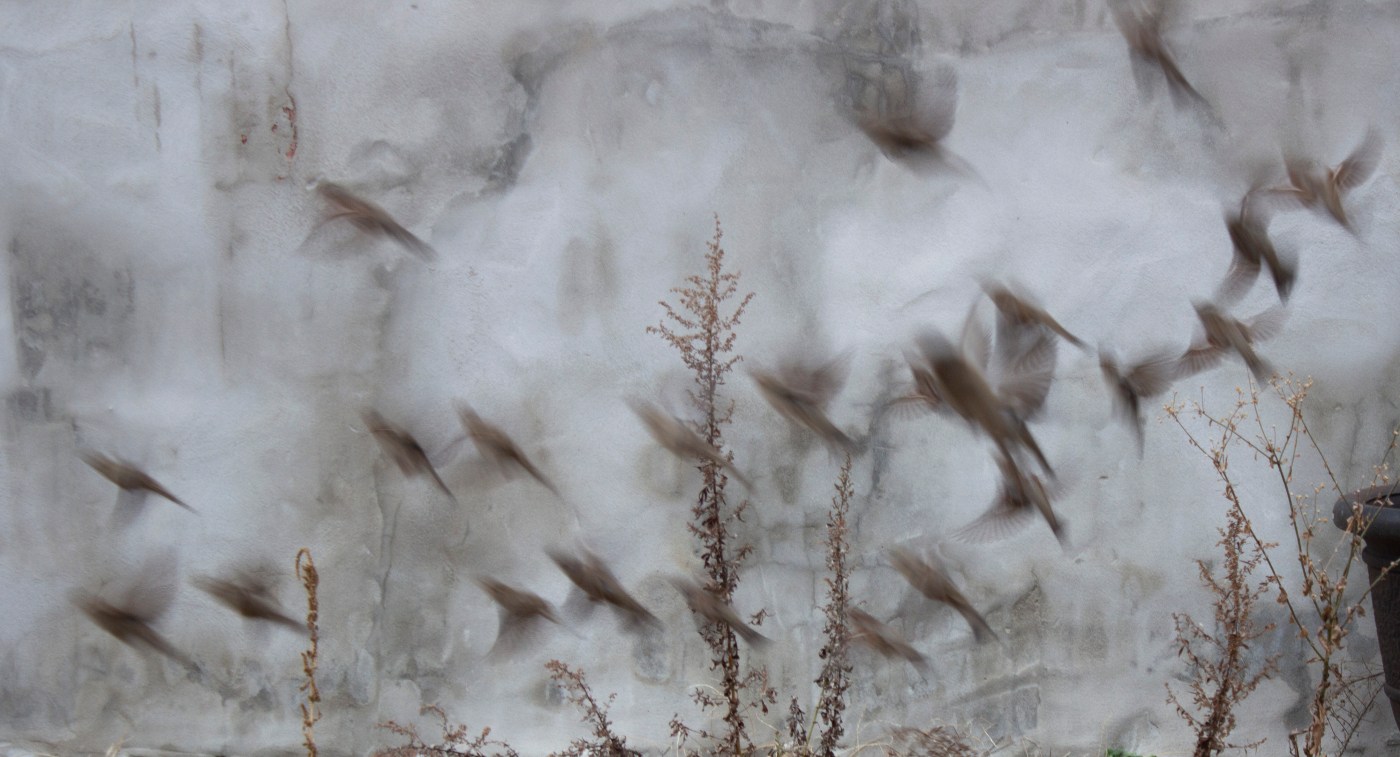
I spent many months sitting in an empty lot where a sunflower had grown through the concrete. During this time I was regularly fasting, and developed a daily practice of sitting before the sunflower and writing in a notebook. I would spread bird seed about on the cobblestones, among the weeds that grew through the cracks and in patches of coarse sand. Horseweed and Broomsedge, Grass Leaved Stitchwort. The purpose of weeds is to bring nutrients to desolate regions. They grow in areas where there is little potential for other life. In their resilience, they electro-magnetically attract minerals from the cosmic ray of the light. In their death, they disseminate their collected nutrients into the desolate region in which they grew. As I would sit and write, the birds would gather; sparrows & mourning doves. The way they pecked at the seeds sounded like light rain patter on a roof. If I were to lift my head from the notebook, the birds would take off in flight, rising in unison with a loud whoosh! and then silence. The empty lot was enclosed by tall walls of concrete and brick. I called it the desert. In the cold months the weeds stood defiantly as their leaves turned brown and died. They turned the color of sparrows. In a fasted state the body feels empty and more transparent, negative emotions subside and one is more capable of communion with the universal currents of life. Inflammation is reduced in the tissues of the body and brain; thinking becomes clearer, time slows down.
“Understood accurately, asceticism is about Beauty; it’s about attempting to be the sort of artists who won’t betray what they have seen of the beautiful.” (Timothy G. Patitsas, The Ethics of Beauty pg. 161)
Hunger is both physical and felt, and also symbolic.The willingness to suffer for the sake of Beauty is a characteristic of the devoted artist. The ideals for which we strive remain, however, unattainable. Failure is the condition of creation, after all. Our hunger therefore, is not enough (or too much!) — it is too much & not enough — both simultaneously. One can not hunger one’s way all the way to the Absolute, or else it means death (and this is the case for Kafka’s Hunger Artist, or Bidart’s Ellen West). Our desire, if considered at its limit, is for something invisible – something not of this world. Therefore it is a desire that cannot be satisfied. Our physical hunger temporarily symbolizes our infinite hunger for something that cannot be found in the world. Rather, it is only during temporary turnings away from the world that our fasting might unite the two very different types of hunger. We fast because we see the beauty that is not there, and the Beauty that is. From this place we learn to bear witness, to pray, and to create.
But there are tensions and dangers in this paradigm of the hunger artist that are difficult to resolve; the fast and the art are deeply personal experiences for the one conducting them (and perhaps cannot be understood by anyone else) and yet they are conducted in relation to a world in which the artist never overcomes (and perhaps longs to be understood by). Kafka’s story The Hunger Artist is about a man who conducts public fasting performances. At first, the performances are met by public acclaim and interest and after each fast is a celebration. But after a time, the interest fades; people stop counting the days or keeping track of the fasts, people who still give attention to the hunger artist start to speculate that perhaps he isn’t even really fasting. The hunger artist remains, however, committed to his art. Eventually, by the end of the story, the hunger artist is all but forgotten by the world, alone in a cage at the back of a zoo.
“An overseer’s eye fell on the cage one day and he asked the attendants why this perfectly good cage should be left standing there unused with dirty straw inside it; nobody knew, until one man, helped out by the notice board, remembered about the hunger artist. They poked about in the straw with sticks and found him in it. “Are you still fasting?” Asked the overseer, “when on earth do you mean to stop?” “Forgive me, everybody,” whispered the hunger artist; only the overseer, who had his ear to the bars understood him. “Of course,” said the overseer, and tapped his forehead with a finger to let the attendants know what state the man was in, “we forgive you.” “I always wanted you to admire my fasting,” said the hunger artist. “We do admire it,” said the overseer, affably. “But you shouldn’t admire it,” said the hunger artist. “Well then we don’t admire it,” said the overseer, “but why shouldn’t we admire it?” “Because I have to fast, I can’t help it,” said the hunger artist. “What a fellow you are,” said the overseer, “and why can’t you help it?” “Because,” said the hunger artist, lifting his head a little and speaking, with his lips pursed, as if for a kiss, right into the overseer’s ear, so that no syllable might be lost, “because I couldn’t find the food I liked. If I had found it, believe me I should have made no fuss and stuffed myself like you or anyone else.” These were his last words, but in his dimming eyes remained the firm though no longer proud persuasion that he was still continuing to fast.” (Franz Kafka, The Hunger Artist)
The deeper spiritual truth that Kafka is writing about involves a paradigm of the existence of the artist. If the artist knew how to live in any other way, he wouldn’t make art, he would merely live. But in fact he doesn’t know how to live, so he turns his incapacity to live into an art; he nourishes himself with his hunger. Of course we see artists “living”, and of course there are situations in which an artist cannot sustain his art practice and falls into the world. Artists fall into the world all the time. But when the artist is baring witness, it is always from a position outside of the world, and always a state of hunger.
According to the Hunger Artist we shouldn’t admire the artist because his art is based on a negation rather than an affirmation. It is his inability that defines his art rather than his ability. In section 59 of Nietzsche’s Beyond Good and Evil, he refers to artists as “burnt children” whose intent is to take revenge on life by falsifying its image:
59.
“Anyone who has looked deeply into the world may guess how much wisdom lies in the superficiality of men. The instinct that preserves them teaches them to be flighty, light, and false. Here and there one encounters an impassioned and exaggerated worship of “pure forms,” among both philosophers and artists: let nobody doubt that whoever stands that much in need of the cult of surfaces must at some time have reached beneath them with disastrous results.
Perhaps there even exists an order of rank around these burnt children, these born artists who can find the enjoyment of life only in the intention of falsifying its image (as it were, in a longwinded revenge on life): the degree to which life has been spoiled for them might be inferred from the degree to which they wish to see its image falsified, thinned down, transcendentalized, deified — the homines religiosi might include among artists, as their highest rank.” (Friedrich Nietzsche, Beyond Good and Evil)
The trap that Nietzsche is diagnosing is that artists and the religious often fall into a mode resentful negation of what is and replace it with a false image of an ideal. The same can be true in the art of fasting, and in the relationship to our bodies; repetitions of these core patterns recur. The whole tension is in the perception of an ideal and the reconciliation with what is.
In Frank Bidart’s poem Ellen West, we are confronted with the inner logic of an anorexic artist. We discover that it is Ellen’s uncompromising devotion to an ideal of thinness that makes life otherwise unlivable. What at first might seem superficial ends up having deeper roots; she realizes a hunger that can’t be stopped with food… “The ideal of being thin conceals the ideal not to have a body”… “Trying to stop my hunger with FOOD is like trying to appease thirst with ink.” This is no different from the core struggle of any artist who must navigate and seek to reconcile a perception of perfection and the flawed work that materializes in practice. In West, we observe the way an obsession with an ideal of perfection results in a devotion to a logic that is incompatible with life in a human body. Only by not eating (a negation) does her hunger merge with her devotion (an affirmation) to an ideal. The poem ends, however, with West coming home from the hospital with her husband,
On the third day of being home she is transformed. At breakfast she eats butter and sugar, at noon she eats so much that – for the first time in thirteen years! – she is satisfied by her food and gets really full. At afternoon coffee she eats chocolate creams and Easter eggs. She takes a walk with her husband, reads poems, listens to recordings, is in a positively festive mood, and all heaviness seems to have fallen away from her. She writes letters, the last one a letter to the fellow patient here to whom she had become so attached. In the evening she takes a lethal dose of poison, and on the following morning she is dead. “She looked as she had never looked in life — calm and happy and peaceful.” (Frank Bidart, Ellen West)
What is haunting, and in contrast to Kafka’s Hunger Artist, is that it is when Ellen West gives up her devotion to the ideal that her death is the result. Kafka’s hunger artist carried the devotion all the way to death. If one negates the affirmation we are left with a double negative – the body becomes an empty space in the world. Neither of these stories seem to give the answer out of the predicament, only pattern diagnosis and warnings. But there is the wider lens to observe from; rather than staying within the stories, we can consider that the artists that made them went on living.
Bidart’s poem is a type of embodiment or performanceof Ellen West, drawing forth the thoughts that make life unlivable in a body, and casting them external into the body of the poem, the thinness of the page. Writing Ellen West, Bidart would later express, “was exorcism. Exorcism of that thing within Frank that wanted, after his mother’s death, to die.” This is a trick of the artist, to transmute and externalize the pain that wants to end the body. (I hear the ghost of Kafka’s Hunger Artist, “But you shouldn’t admire me.” )
Ellen West (a real person Bidart read about) in her life was never able to make the motion; her art was insufficient to complete the exorcism. At one moment in Bidart’s poem West is being observed by the hospital attendant: “In her diary, writes that art is the “mutual permeation” of the “world of the body” and the “world of the spirit”. Says that her own poems are “hospital poems…weak – without skill or perseverance; only managing to beat their wings softly.”
For Bidart and for West the struggle in art is the struggle of the spirit to embody itself, to manifest itself. “She, who in the last months of her life abandoned writing poems in disgust at the failure of her poems, is a poem.” “She in death is incarnated on a journey whose voice is the voice of her journey”. West in some way dies for Bidart, in the place of Bidart. In Kafka’s story the withered hunger artist dies and is replaced by a black panther, pacing in the cage.
In my own life during this time of hunger in the desert, the voice of Lene Marie Fossen accompanied me for a time. Lene was an artist who stopped eating at age 9 because she didn’t want to age any further. Fossen discovered the link between time and the body in some profound way that became entirely unlivable. She reached the age of adulthood without ever having gone through puberty. It was only as an adult when she began a practice as an artist that she felt inspired to eat, because she needed energy to make her photos. Her artistic hunger nourished her for a time. Her photos are self-portraits taken in an abandoned leper hospital – they are deep, melancholic images of suffering and strength that can meet a viewer at any depth. They are self-surrendering images, she offers her body to the viewer as one that can hold our pain. She died, however, at age 33, unable to resolve her hunger.
*
As we can see there is grave spiritual danger to these hunger occupations. Situated between a perception of the the ideal and recognition of decay, one can make the motions to discover the position of hunger from which bearing witness and creating are possible, and think this is enough (or too much!), but it is not. Those who are driven to fast have to come into a confrontation with both the part of themselves that wants to die, as well as the part of themselves that is afraid of death and that wants to be admired. Neither part has the answer and both must be overcome. The fast is spiritual warfare. One is revealed to oneself. One must learn to choose life, but this can become difficult to discern.
“Asceticism comes before moral struggle, and that asceticism is the struggle of the artist to create honestly and within the bounds set for his art. Asceticism is Chastity in our devotion to God. It is rejection of self-love and every other form of idolatry. In other words, we should struggle to keep our eye sound, rather than focus on resisting the negative.” (Timothy G. Patitsas, The Ethics of Beauty pg. 164)
There is a positive angle to asceticism in relation to art. Fasting puts us in touch with a deeper part of ourselves, there is a double movement that occurs when we willingly forego food — we become more sensitive to subtle etheric energy while also re-associating with the most earthy primal parts of being a body. Fasting is one way to heal a disassociation from the body, but like any “pharmakon”, it can be either remedy or poison depending on how its applied and can also lead to disassociation from the body. The disassociation takes the form of harmful habits we carry out in ignorance. Learning how the body works and functions is the difference maker in our ability to care for ourselves. We will fare better as we learn to focus on the affirmative rather than the negative. Our hunger must draw us along into a self-offering devotion and we must learn not to turn our hunger into merely a withdrawal and a resistance in isolation.
“Fasting is training for spiritual warfare and it prepares a part of our minds and souls that is more basic than willpower.” (Timothy G. Patitsas, The Ethics of Beauty pg. 162)
On a physical level, what happens during fasting is that long-stored waste, mucoidal plaque and toxic material begins to leave the body. There is an intelligence in the body that has the opportunity to operate once there is no digesting to do. The code of the body is life. The intelligence at work in the body is doing everything it can to restore the body to life, and to remove death and decay from the body. The purpose of fasting, when conducted within rational bounds, is to get the body out of a degenerative state and into a regenerative state. When the body burns old reserves of fat it both processes the stored toxins into the elimination channels and also releases stem cells that begin the regeneration process. Once one perceives the degree of degenerative filth that the body has accumulated it can be alarming to recognize what one has done in ignorance. By way of contrast one gains a vision of the potential of the human body to exist in a purified and regenerated state. Detoxifying the body can feel like a way of paying penance or atoning for sins on a very physical level. But here the primary tension of the hunger artist begins – between the perception of the pure ideal and the lived embodiment, and the distance is vast, haunting, and can lead to an obsession in which it becomes difficult to discern the forces of life and the forces of death. We eat to live and we eat to die. The true potentials of the human body are likely yet to be realized — or remembered. There are countless examples given in the works of Herbert M. Shelton, Hilton Hotema, and Arnold Ehret of human beings going vast extended periods of time on no food at all. Hotema maintains that the human being currently exists in a degenerated state and that in a distant past the human body lived on breath and sunlight alone. Ehret believes that constipation and obstruction to blood-flow caused by mucus-forming foods is the primary cause of all disease. This is the battleground the one who fasts will discover for himself. There is no question that fasting is an incredibly powerful tool when used rationally for healing. And Kafka’s hunger artist isn’t entirely wrong – there is a lot of “food” in the world that we would do well to unlearn our appetites for. “Before you heal someone ask them if they are willing to give up the things that made them sick”, says Hippocrates, the ancient Greek healer. When we fast we demonstrate a willingness to give up what makes us sick. However, I would like to avoid getting too far into the technical side of fasting and remain focused on the underlying traps in the consciousness of an artist who looks to resolve hunger with hunger, and to provide potential resolutions. I’ll only mention one more note here that could be developed; the one thing that both the artist and the one who fasts have in common is a preoccupation with what comes out of the body.
Asceticism is a method of withdrawing from habits and actions; the first motion of the ascetic is a negation and resignation. It’s important that we are able to make this first motion in order to create change, however, one cannot remain in the isolating region of withdrawal for very long if they do not discover the next motion: a self-surrendering return to a practice of being in the world. There is a danger to the stage of withdrawal and one must be careful not to fall into a solipsism that denies the relation to others. One can also become stagnant emotionally and spiritually when commitment to the technicality and physicality of the fast becomes the sole focus of our hunger. There are further motions to make, and there are patterns for these motions that have been laid out for us to consider. The prophet Isaiah teaches the right and wrong modes of fasting in chapter 58 when he chastises those who fast to appease God but do not carry charity within their heart. Bodily performance and exercise through fasting is not enough, and can even be harmful if it inflates our sense of self-pride or false sense of superiority. Our fasting must somehow be put in service of something beyond ourselves whereby we make an offering of our hunger. What makes Catherine of Siena different from Ellen West?
The case of Catherine of Siena is interesting and worth reflecting on for a moment here. Beginning in childhood, Catherine of Siena hardly ever ate. As word of her prolonged fasts circulated, people cast their doubts and slanders.
“Some muttered that she probably fasted publicly and stuffed herself with food in secret. Later Catherine complained sometimes that she wishes with all her heart that she could eat like other people, so that she could avoid causing annoyance. When it gave her the most terrible pain to swallow anything, and her stomach could not retain anything that she forced into it, she said that she believed it must be a punishment for her sins, and especially for the sin of gluttony, for she had been so greedy for fruit when she was little…
Many took exception to the fact that she went so often to Communion. This was not usual at that time, for many were afraid that the devotion and awe due to the great mystery which is the Blessed Sacrament would be lessened if one received it too often. Even pious monks seldom received the Blessed Sacrament more than once or twice a week, and it had not yet become the custom for priests to celebrate Mass every day. Many of her sisters in the order, and also many of the Dominican monks, did all they could to try and lessen Catherine’s desire to take Communion so often — partly because they thought that such a violent hunger for the Sacrament could not be completely sincere, and partly because they disliked the sensation caused by her ecstasies, which followed after she had communicated. The curious came to stare at the ecstatic virgin, the enemies of religion scoffed, and simple and pious people were disturbed in their devotions.” (Catherine of Siena, Sigrid Undset, pg. 102)
When she did eat, which was seldom, it was fruit juice or raw leafy greens only, which she spit out after chewing. However, each day Catherine would attend Mass where she would receive Communion, and consume the Eucharist (the body of Christ). It is, after all, the body of Jesus that theologically resolves the tension of the separation between the perfect ideal and the human body; Jesus unites in his body the absolute and the relative, the eternal and the temporal, man and divinity. Upon receiving communion Catherine’s body would grow rigid and she would go into an ecstasy in which she spiritually departed from her body, sometimes for several hours.
“Ecstasy occurs when the soul withdraws its attention from the use of its senses and turns to a consideration of supernatural beauty which lifts it out of itself. Then it hears nothing and sees nothing and the vital functions of its sensitive powers seem to be suspended. It is obvious that the body of Christ is not in the Eucharist according to the laws of other bodies. Because of their quantity, the latter occupy place, whereas He is present in a way that makes Him more lovable and admirable than do any of His other works.” (The Cross of Jesus, Louis Chardon, pg. 97)
Catherine would return to her body after an experience of mystical visions and encounters with Christ and various saints. During these ecstasies people would sometimes poke her with needles to which she remained unresponsive, in many cases spectators reported that her body seemed to be levitating.
When the soul is carried off to distant heavens and enjoys completely intellectual visions, it is made independent of the body, and in its longing to be made entirely one with what it sees — God — it passionately desires to be wholly free of the body. If God did not in a miraculous way maintain life in the body, it would disintegrate and perish. When the soul afterwards returns to the lower sphere, it seems like a humiliation; it is as though the soul in its knowledge of divine Perfection and its own imperfection drifts on outspread wings between two abysses. Confident and blessed, it has touched the shores of eternal life, but as long as it remains one with the mortal body it cannot have peace either in the hereafter or in this world. (Catherine of Siena, Sigrid Undset, pg. 149-150)
We find all the same tensions in the theological desire for the Absolute as we do in the artists devoted to ideals. The devotion to an ideal of purity conceals the desire not to have a body. The knowledge of divine Perfection results in the body becoming a humiliation. One drifts on outspread wings between two abysses. Catherine, in her book, The Dialogue, elaborates on this theme (the voice speaking is God, through Catherine):
“So also my other servants who have arrived at the third and fourth stage of perfect union with me: They cry out with Paul, wishing to be separated and set free from their bodies.
84
Death gives these souls no difficulty: They long for it. With perfect contempt they have done battle with their bodies. Therefore, they have lost that natural tenderness which binds soul and body, having dealt the decisive blow to natural love with contempt for bodily life and love for me. They long for death, and so they say, “Who will free me from my body? I long to be set free from my body and to be with Christ.” And such as these say along with Paul, “Death for me is in perfect longing, and life in patience.” For the soul who has risen to this perfect union longs to see me, and to see me praised and glorified. Afterwards she returns to the cloud that is her body – I mean her feeling, which had been drawn into me by the impulse of love, returns to her body. I told you that all the body’s feelings are drawn along by the force of the soul’s affection when she is united with me more perfectly than soul is united with body, thus drawing that union into myself. For the body is not capable of bearing such a union constantly. That is why, though I remain in grace and in feeling, I withdraw so far as union is concerned. But I always return with greater increase of grace and with more perfect union. So it is always with a heightening of my truth that I return, revealing myself to the soul with greater knowledge. And when I withdraw in the way I told you so that the body might return for a while to its senses, the soul is impatient of life. For she sees herself taken away from her union with me, taken away from the company of the immortals who glorify me, and finds herself instead in the company of mortals, whom she sees offending me so miserably.
This is the crucifying desire these souls endure when they see me offended by my creatures. Because of this, and because of their desire to see me, life is insupportable for them. Still, because their will is not their own and has in fact become one with me in love, they can neither will nor desire anything but what I will. Though they long to come to me, they are content to remain with their suffering if I want them to remain, for the greater glory and praise of my name and for the salvation of souls.” (Catherine of Siena, The Dialogue)
God withdraws himself from the soul so that it returns to life in a body in the world. The desire to die is resolved by recognition that the death of the body is not God’s will. One surrenders oneself to the will of God and must reckon with how to live. This is where asceticism leads to morality. After mystical union the soul sees ever more clearly the fallen world of sin and decay that we inhabit. There is tremendous sadness in this perception. We discover humility when we recognize that we are complicit in this fallen world, and that change begins with us. In Catherine, the mystical raptures always led to a devotion to a life of service. Catherine always returned to the world and to a responsibility to the other. Solitary union with God results in solidarity with the world. She lived during the years of the Black Plague in Europe and remained unwavering in her care for the sick and the poor. The highest ascent of her spirit into communion with the divine becomes inseparable from the deepest descent into the suffering of the world. Saint Catherine inspires us to realize that the supernatural is the real. Through her life and teaching we can learn to ground our existence in God; to recognize that we are sustained by a higher power and are nothing without it. Catherine helps us to to see that there is a bridge between the absolute and the relative, between perfection and flaw, and this bridge is built with our acts of service, and with our kindness to others. When we return to the world after our infinite resignation it is by works of faith and with works of love that we direct our hunger.
“To what end, suffering? This conversation must begin with the goodness of human life, and that suffering does not have the final say about mortality and immortality. We have too easily believed that we are mere mortal beings, when in fact we are, but the plan of God, mortal only with regard to this world, but immortal so as to enjoy God forever. Because we do not create ourselves or the ethical dimension of human life, but life and the way we live is grounded in the Eternal Law of God, we owe it to Him (and ourselves) to hear what He has to say about all of life, including its seasons of suffering.” (Paul Jerome Keller, Introduction to The Cross of Jesus by Louis Chardon)
Our hunger can be given to a solidarity with the suffering in the world. We can hunger for justice. The Law was perhaps created by human beings with a vision of an ideal and the same tensions that exist in the single body that hungers can be said to exist in the body of a people – between a vision of a just society and the lived reality of corruption.
“It had gradually come about that Italian and European politics was one of the chief concerns of the Seraphic Virgin of Siena. The artificial division of religion and politics did not exist for the people of the Middle Ages. If they thought over the matter at all, they were completely aware that all the problems concerning the community — good or bad government, the welfare or misery of the people — are in the final instance religious problems. The fundamental question is, What do we believe a man to be? What is it he needs, first and foremost, so that he may be in a position to attain all his secondary needs — peace, justice, security, satisfactory relationships with his fellow men?
Catherine never had any doubts about the answer. A man is nothing by himself, had nothing from himself. His existence is in his Creator, everything he is and owns is from his Creator. United with is Creator, who is boundless Love, eternal truth, Wisdom personified, man receives his share of the qualities of the Divine – within the limits of humanity. If a man loves God, he will be able to love his neighbor, to attain wisdom, and to be just and truthful. Because God is our eternal blessedness, a child of God becomes a blessing for his fellows. Love for one’s own ego, for something which is in reality nothing, leads to an abyss of nothingness. The love of a selfish man is nothing, truth escapes between his hands, his wisdom will show itself to be foolishness, his justice injustice, and in the end a series of disappointments and mistakes will lead him to hell — to the devil who is the spirit of disappointment and barrenness. “Unless the Lord build the house, they labour in vain that build it.” Catherine knew the truth of these words.” (Catherine of Siena, Sigrid Undset, pg. 140-141)
There are many examples in history in which fasting has become a political tool used to effect change. Catherine didn’t fast for political reasons, but understood how hunger relates to justice and of how our actions are symbolic. “Blessed are those who hunger and thirst for justice, for they shall be satisfied (Matthew 5:6). Ghandi is among the most famous examples of one who fasted to effect change on a political level, but there are many other such examples as Bobby Sands and the 9 other Irish Republic Army members who went on hunger strike to protest the removal of Special Category Status and their treatment as prisoners in a British prison in 1981. Or Simone Weil who refused to eat anything more than what was served by the Germans to the French in occupied zones during 1943; her hunger was a hunger of solidarity and her death at the age of 33 takes on new significance. More recently in New York City there was a hunger strike conducted by taxi cab drivers. Richard Chow, Augustine Tang, and Basia Osowki led a hunger strike in solidarity with thousands of taxi drivers who have been unable to find relief from crushing debt due to predatory loans and the rising cost of the medallion required to operate a yellow cab in New York. Mayors Michael Bloomberg and Bill de Blasio enthusiastically encouraged this practice because medallion sales translate into tax revenue. On top of this predatory loan/debt practice, Uber and Lyft have entered the market with unregulated cars and yellow cab drivers find themselves in an impossible position. Cab drivers began killing themselves, one of which was Richard Chow’s brother, who abandoned his cab outside the mayor’s residence and then jumped into the East River.
About six weeks later, the hunger strikes began: for fifteen days, Chow and others subsisted on water and Gatorade. Their efforts paid off in early November, when the city and lenders finally agreed to restructure driver debt, significantly reducing monthly payments and guaranteeing the loans.
As Bhairavi Desai, leader of the Taxi Workers Alliance, later said, this is all that drivers wanted — fair terms, not a free ride. They also want to help their ride-app brethren, mainly other immigrants, who don’t earn enough to live on, don’t receive benefits, and are largely prevented by their employers from organizing. The way we think about full-time work has to change, she said, with labor at the center of our concern rather than municipalities, corporations, and banks. This will be especially important as New York and other cities welcome the return of foreign tourists. As for Chow and the rest, they were set to return to the job after a painful period of “refeeding” — adjusting to the intake of solid food. It should not have come to this, but through their actions they and their fellow drivers embodied the half-century-old example of Chavez, who on completing his own hunger strike in 1968 stated that “the truest act of courage…is to sacrifice ourselves for others in a totally nonviolent struggle for justice.” (Dominic Preziosi, Commonweal magazine December 2021)
The body is a political battleground. To reclaim bodily autonomy is no small task, and once one is prepared to suffer with the body in devotion to a cause — to sacrifice oneself for others in a nonviolent struggle for justice — a new frontier of potential action opens up; our capacity for freedom expands. We learn how to redirect our drives. Our freedom expresses itself in our ability to resist, rather than the capitalist notion of a freedom of infinite choice for satisfying our appetites. To learn the fine art of fasting is one route toward both reclaiming bodily autonomy and restructuring our relationship to desire and power. Rediscovering the body is learning to care for ourselves; we deepen in self-respect. When we do this we learn how to redirect the power that is exerted over the body, and we rediscover our connection to the sacred.
I turn one last time to Saint Catherine of Siena, before concluding.
Catherine writes in a letter to the Pope, “The only thing we lack is hunger for the salvation of our neighbor, and courage. But to arouse this hunger in ourselves, who are nothing more than barren trees, we must graft ourselves to the fruitful tree of the cross. The Lamb who was slaughtered for the sake of our salvation still thirsts — His desire for our salvation is greater than could be shown by His suffering — for His suffering is without end, as is His love.”(Catherine of Siena, Sigrid Undset, pg 188)
The question is how do we live with purpose and beauty, devoted to justice; to what do we offer our hunger? When we fast we demonstrate the willingness to suffer (to live) for the sake of what perfection one has perceived in the mind. Our freedom is a freedom to resist the temptation of our worldly appetites and to recollect our freedom in the act devoted to the perfection, justice, and beauty we see in our minds. We die to the world when we perceive divine perfection and true justice in our minds. However our perception is fleeting and its intensity is not livable. We fall back into the world, and must make the choice to again confront and surrender ourselves over to the exteriority of the world, in service to the other, and to the Absolute Other (God).
There are patterns for surrendering ourselves to the exteriority of the world. For example, to willingly go into a state of hunger is also a way to practice solidarity with the hungry and a way to symbolically express that we are a far way away from being nourished by Justice, Truth, Beauty – we hunger. When our hunger is given over to a solidarity with the suffering we confront the other exterior to ourselves, even if it remains an unknown and remote other, we change the direction of our attention and learn to surrender ourselves to the will of a higher power. This is one way to make life a prayer. We give our hunger over to the universal current of life that it might be carried to those whom it may, like invisible birds flying toward heights unknown. We surrender this task up to God and the Holy Spirit, the great weaver, the unifying intelligence that weaves through all space & time. This is, however, a purely metaphysical composure of the mind and the heart. For the artist, the spiritual motion is identical but now there is a material object. The art object is created to be released to a world outside. The artist must complete the motion in a recognition of the other, even if it be unknowable others, and give the art over to the Absolute Other in a gesture of unconditional love, surrendering to an infinite yonder with a promise to let go.
“Now, only recently, being on the point of giving my last squawk, I thought of looking for the key to the ancient feast where I might find my appetite again.
Charity is that key. — This inspiration proves that I have dreamed!”
(Arthur Rimbaud, A Season in Hell)
I believe the motions of these gestures have meaning even if the result cannot immediately save anyone from starving, or keep the world from becoming hostile and empty. To hold charity in the heart without anticipation is to surrender oneself to life and become more capable of realizing our capacity for freedom.
*
I return at last to the memory of my time in the desert, sitting each day in hunger with the sunflower and the birds. Birds in flight occupy a liminal realm of motion rather than fixed form, they appear to be somewhere in between embodied and invisible.
“Bachelard thought that identity is neither fixed nor illusory. Individuals are in a state of perpetual metamorphosis as they are born, wake, sleep, daydream, work, and eventually die. One highly visible symbol of such transformation is a bird taking off toward the heavens. According to Bachelard, birds are transformed in flight. They move constantly, varying their form according to the winds. Their colors change as well, flickering as they are touched by light from different directions.
They seem to leave behind their corporeal reality, much as people do in dreams, a phonomenon Bachelard calls “oneiric flight” (vol onirique). This is essentially the flight of Daoist immortals. Bachelard believes it to be the foundation of poetry, where objects are deprived of mass. The avian alternation of flight and activity on the ground is like the dialogue of imagination and reality that makes up human culture.” (Boria Sax, Avian Illuminations (referencing Gaston Bachelard), pg.32)
At the time, I considered the birds companions. I wasn’t aware of why I was drawn to beholding the birds, watching them lift off and land, it was an instinctual attachment and it’s taken me more than a year to come to understand its connections to the underlying patterns of consciousness that were at play. The bird offers an image that is situated at the primary tension of the hunger artist – between a flight toward an ideal, and residence within a body.
“How do you know but ev’ry Bird that cuts the airy way, Is an immense world of delight, clos’d by your senses five?”
(William Blake, A Memorable Fancy, The Marriage of Heaven and Hell)
Each day I sat before the sunflower with the birds. I disembodied myself into the body of the sunflower, offering it my emptiness. I wrote in place of the sunflower, offering it my hand; I allowed the sunflower to occupy my empty body, that I might become its scribe. In the end the sunflower died for me, as if an embodiment of Christ, and I have gone on and returned to myself, chosen to bloom nonetheless. Now, I offer this writing in a gesture of surrender. These thoughts have grown like weeds in a desolate region, they have gone through a life-cycle, and perhaps in their dying they might enrich the dust in which they rest.
*
written January 2023
age 33
*
 theslowangel.com
Leave a comment