
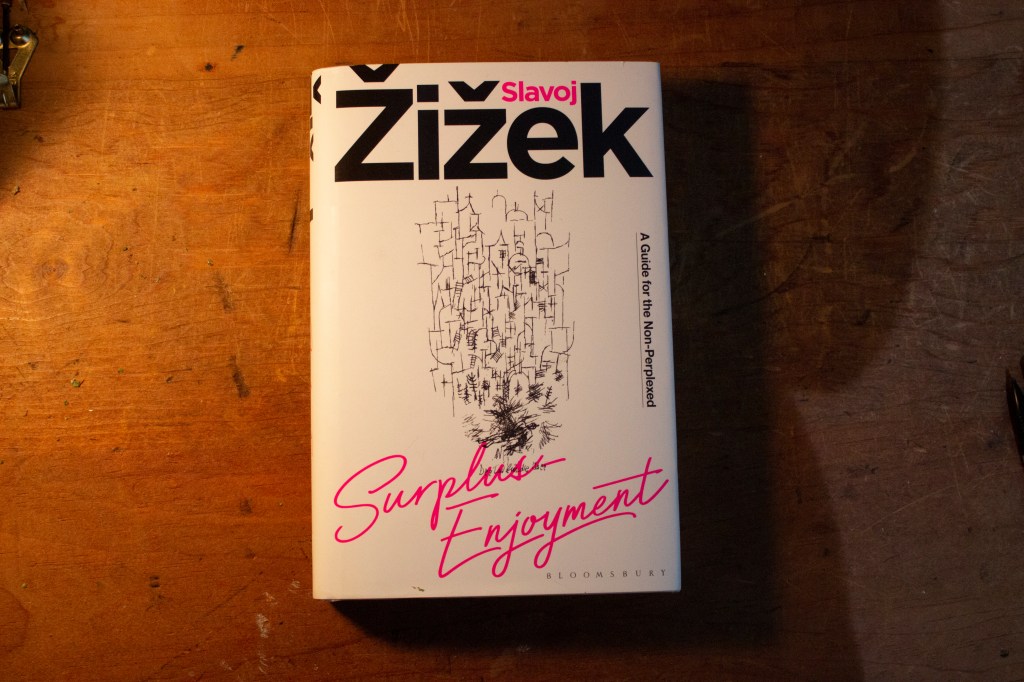
An excerpt from Slavoj Zizek’s Surplus Enjoyment, with link to the entirety of Meister Eckhart’s sermon The Poor Man
pdf link to Meister Eckhart The Poor Man:
https://stillnessspeaks.com/wp-content/uploads/2015/09/MeisterEckhartThePoorMan.pdf
*

*
“The unique role of Christ is something that escapes mysticism even at it best, which means, of course Meister Eckhart. Eckhart was on the right track when he said that he’d rather go to hell with God than to heaven without – but his ultimate horizon of the mystical unity of man and god as the abyssal Oneness in which man and God as separate entities disappear prevents him from drawing all the consequences from his insight. Let us quote extensively from Eckhart’s Sermon 87 (“Blessed are the poor in spirit”) which focuses on what does true “poverty” amounts to:
as long as a man still somehow has the will to fulfill the very dear will of God, that man does not have the poverty we are talking about; for this man still wills to satisfy God’s will, and this is not true poverty. For, if a man has true poverty, then he must be as free of his own will now, as a creature, as he was before he was created. For I am telling you by the eternal truth, as long as you have the will to fulfill God’s will and are longing for eternity and for God, you are not truly poor. For only one who wills nothing and desires nothing is a poor man … Therefore we say that a man should be so poor that he neither is nor has a place in which God could accomplish his work. If this man still holds such a place within him, then he still clings to duality. I pray to God that he rids me of God; for my essential being is above God insofar as we comprehend God to be the origin of all creatures. In that divine background of which we speak, where God is above all beings and all duality, there I was myself, I willed myself and I knew myself, in order to create my present human form. And therefore I am my own source according to my timeless being, but not according to my becoming which is temporal. Therefore, I am unborn, and, in the same way as I have never been born, I shall never die. What I am according to my birth will die and be annihilated; since it is mortal it must decompose in time. In my eternal birth all things were born and I was the source of myself and of all things; and if I had so willed there would be neither I nor any things; but if I were not, then God would not be, for I am the cause of God’s existence; if I were not, God would not be God. However, it is not necessary to know that.
Eckhart relies here on the distinction between me as a creature, part of the realm of creatures with God (the origin of all creatures) at its apex, and between the eternal impersonal I that is one with God beyond all creaturely life (“as I stand empty of my own will, of God, of God’s will, and of all His works and of God Himself, there I am above all creatures, I am neither God nor creature, rather I am that I was and will remain, now and forever”). But this distinction is not enough to really account for Eckhart’s own claim that it is better to be in Hell with God than in Heaven without God.
One has to be precise here – Eckhart does not talk about Christ, but about God: “ich will lieber in der helle sin und daz ich got habe, denne in dem himelriche und daz ich got nit enhabe” (“I would rather be in hell and have God than be in the kingdom of heaven and not have God”). It is my contention that one should replace here “God” with “Christ”: one cannot be without God in Heaven because God IS Heaven, and the only way God can be in Hell is in the figure of Christ. The reason we have to replace “God” with “Christ” is thus simply that this is the only way to make Eckhart’s proposition meaningful in a Christian sense. (We have here a nice example of how a misquote is closer to truth than the original.) Or, to go a step further: not only is a world without God Hell, but God without Christ (i.e. God in his separation fro man) is the Devil himself. The difference between God and the Devil is this that of a parallax: they are one and the same entity, just viewed from a different perspective. The Devil is God perceived as a superego authority, as a Master enacting his caprices.
The mystical unity of my I and God in which we both dissolve is beyond Heaven and Hell, there is even no proper place for Christ in it, it is the void of eternity. Insofar as we nonetheless define Heaven as the bliss of eternity in which I am fully one with God, then Christ as an embodied individual, As a God who is simultaneously a mortal creature (dying on the Cross), definitely belongs to the domain of Hell. In their “Engel,” Rammstein describe in simple but touching terms the sadness and horror of angels who dwell in Heaven afraid and alone, sad because there is no love up there – maybe the deadly-suffocating love of God which is a mask of His indifference. God-the-Father knows I don’t want to be an angel, but He keeps me there. Love comes only through Christ, and Christ’s place is in Hell where life is, where passions divide us. And there is a step further to be made here: if, in order to reach the abyss of the Void, I have to get rid of God himself as the supreme creature, the only place to do it is Hell where God is by definition absent. To step out of the realm of creatures one has to descend to the lowest level of creaturely life which is Hell.
In his provocative claim, Eckhart doesn’t only imagine where to be with or without Christ, he proposes a real choice we have to make, the choice between God and Christ, and it is the choice between Heaven and Hell. Rimbaud wrote in his A Season in Hell: “I believe I am in Hell, therefore I am.” One has to take this claim in its full Cartesian sense: only in Hell can I exist as a singular unique I, a finite creature which is nonetheless able to separate itself from the cosmic order of creatures and step into the primordial Void.
Eckhart progresses from the temporal order of creatures to the primordial abyss of eternity, but he avoids the key question: how do creatures arise from this primordial abyss? Not “how can we reach eternity from our temporal finite being?” but: “How can eternity itself descend into temporal finite existence?” The only answer is that, as Schelling saw it, eternity is the ultimate prison, a suffocating closure, and it is only the fall into creaturely life which introduces Opening into humans (and even divine) experience.
(Slavoj Zizek, Surplus Enjoyment, pages 252-254)
*
\
 theslowangel.com
Leave a comment