“How could such a conversion be produced from out of the absence of epoch? By creating worlds in the befouled unworld [immonde], by again giving room (for), by proliferating acts of taking place in a thousand places making (the) différance. This is what we are told by René Char and Italo Calvino, giving birth in sites of urbanity to miraculous relations of mutual admiration where the hell or the inferno recedes before what, ‘in the midst of the inferno, are not inferno, then make them endure, give them space’. This place, which is also a (khōra), is the place of neganthropological différance – whose advent in Gestell must occur as a leap into a new era.”
(Bernard Stiegler, The Age of Disruption, pg. 308)
*
“To continue to struggle, faced with the evidence of the absolutely desperate nature of the situation – that is, to stop denying the state of emergency into which the Anthropocence has led us, taken to the extreme by disruption – it is necessary to believe in the possibility of a miracle, and, more precisely, to believe in the miracle of what I am here calling the Neganthropocene.
Let us repeat it once again: such a miracle is a dream. This dream must be immensely noetic, capable of projecting the pharmacological situation in advance by turning it into its point of departure – by positing the irreducibilitty of this pharmacological situation from the outset, which is to say the impossibility of eliminating entropic consequences, and, correspondingly, the constant need to neganthropologically take care of the pharmakon.
In the past, the name given to unconditional belief in the possibility of the miraculous was faith, itself founded on the form of desire that Christianity called (agapē). In the epoch of the absence of epoch to which the death of God has led, such an affirmation of the possibility of what can only appear impossible, which is the improbably as such, that is, neganthropy with respect to entropic becoming, can no longer constitute a faith in Providence, nor can it be the expectation of a divinity. This, however, raises questions about a new form of belief an a new relationship to fidelity and infidelity.
It is in this sense that we should, no reject Heidegger’s statement in Der Spiegel, but subject it to critique, that is, take it seriously, analyse it in terms of its fundamental inadequacies – in this case, the exclusion of questions of entropy and negentropy from Heideggerian thinking. Here, it is no longer a question of the ontological difference between being and beings, but of the neganthropic (and exosomatic) différance between future [avenir] and becoming [devenir].
It is not a new god who alone could still save us (even temporarily through a différance of and within entropy that can but remain the fate of the cosmos – this fate being, in local terms, the cooling of the solar system), but the new belief required for the transvalutation of all values, which presupposes that we ‘transvalue’ Nietzsche himself.
Miraculous narratives are parables of the neganthropic condition inasmuch as it is always exceeding itself, and such that it can never amount to a simple ‘humanism’. Because it is hybrid, and because the [ubris] it contains always exceeds it, what we call ‘man’ – the non-inhuman being that we should henceforth name Neganthropos – is both in excess and in default of itself: it is never itself.
It is this excess, inasmuch as it ‘transcends’ the default that it is, that takes the name of spirits, gods, God, History, or Gestell, and this is what jihadism as well as transhumanism and neo-barbarism try try to recuperate at the moment when this excess shows itself to also be the default as default of origin.
Excess and default are what Heideggerian existentialism, in spite of all that it brings to such a perspective, is ultimately incapable of conceiving. This is the objection to Heidegger that Derridian deconstruction is attempting to make. The consequence of this inability is that the place (Ort) of the ontological difference (that is, of ‘meditative thinking’) becomes the ‘native land, ‘autochthony’. The excess and the default from which neganthropological différance stems, however, are at the same time what localizes the default as idiomatic difference and what de-localizes (exceeds) it as what is necessary beyond the locality where it is constituted, drawing it out towards the non-place of what, in becoming, remains to come, and as the quasi-causal taking place of a promise. For centuries, this excess was experienced as that transcendence whose name was God.”
(Bernard Stiegler, The Age of Disruption, pg 303-304)
*
Stiegler is not a Christian. He became a philosopher while incarcerated at Saint Michel Prison after a series of bank robberies he conducted alone. I find that reading his work, however, is not incompatible with certain themes of Christian thought. Christ was crucified between two thieves, after all.
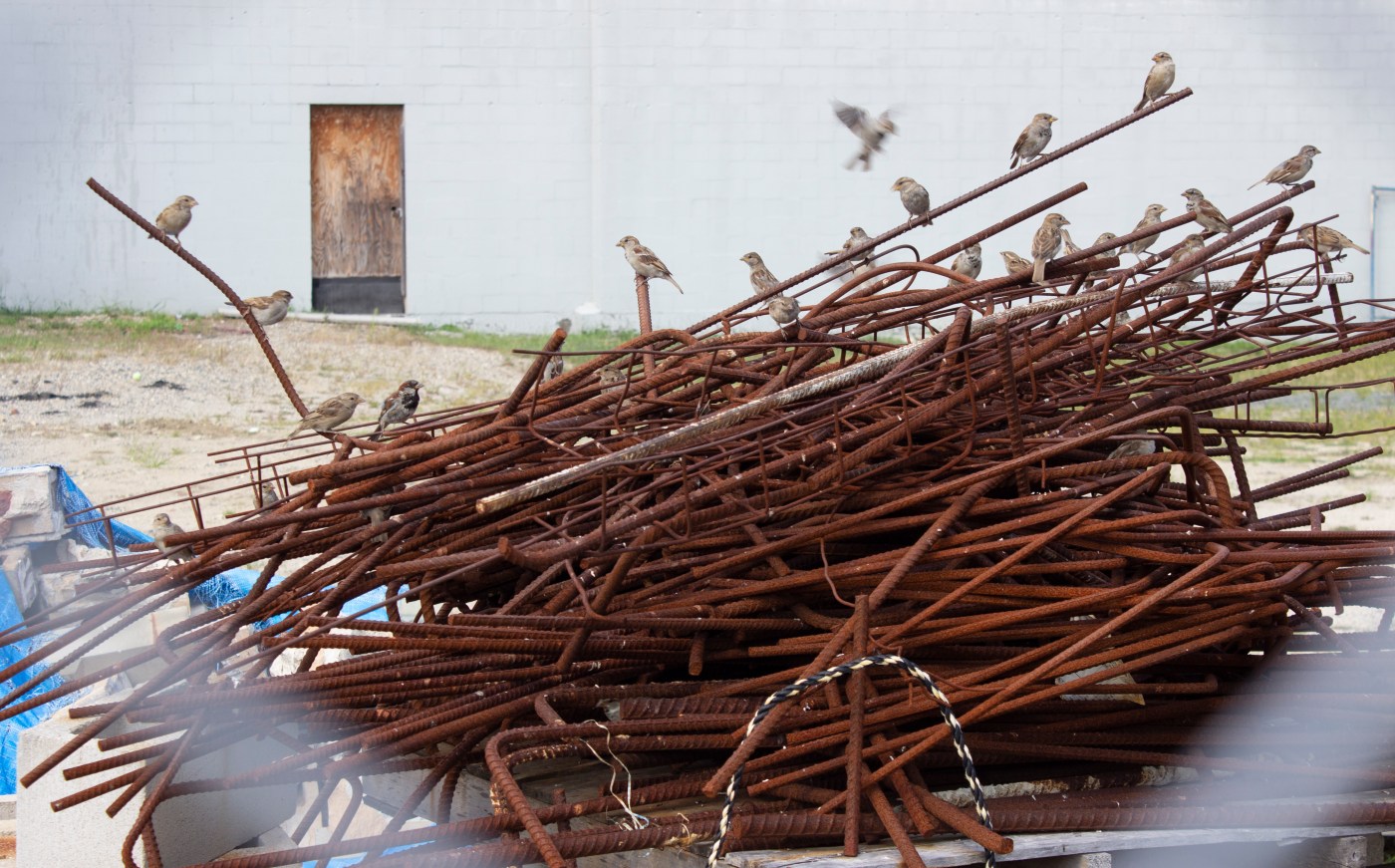
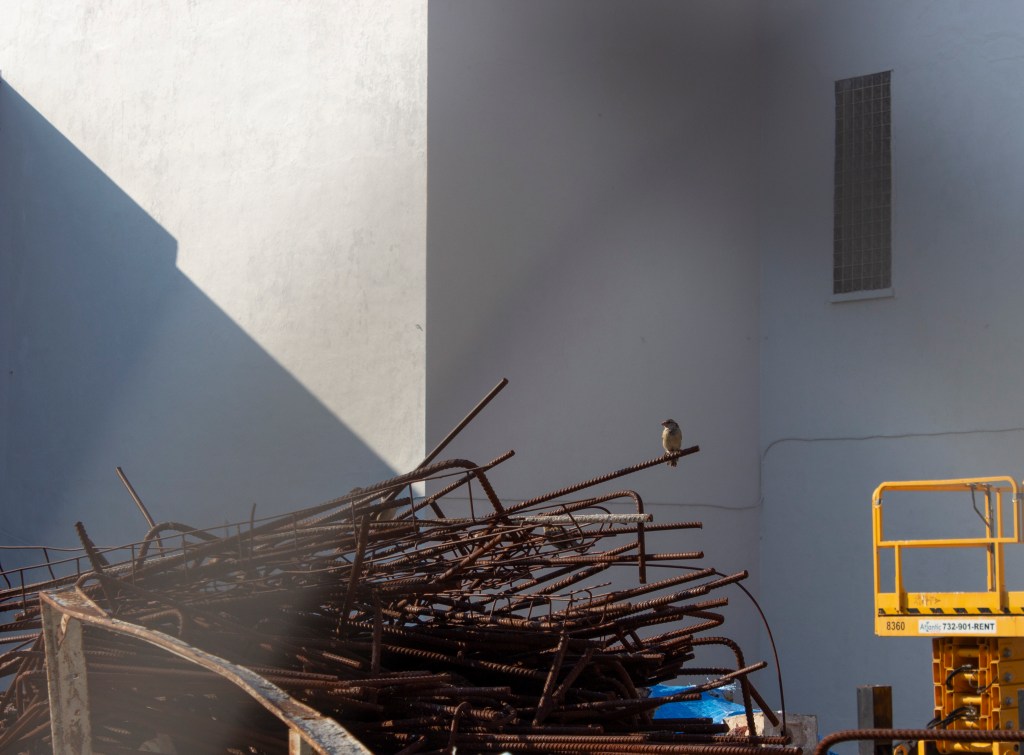
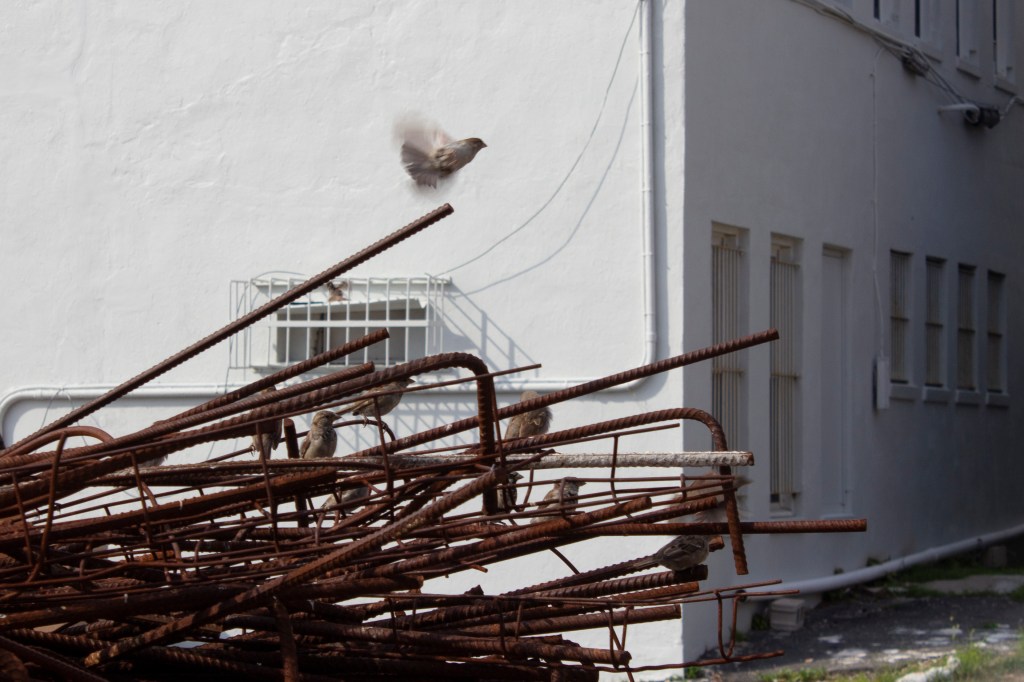
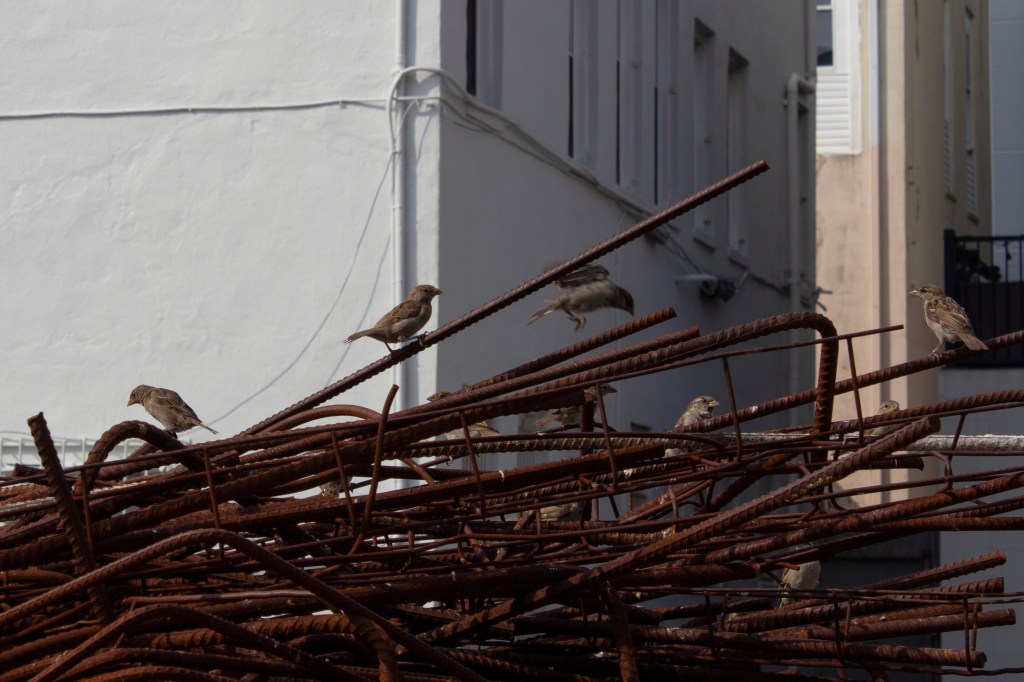
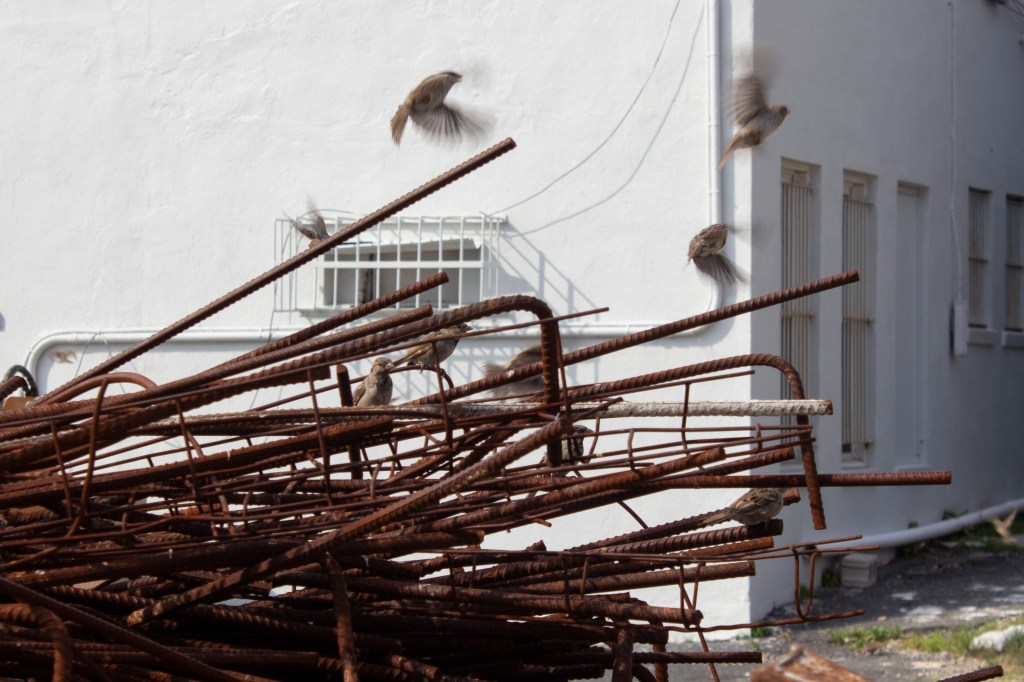
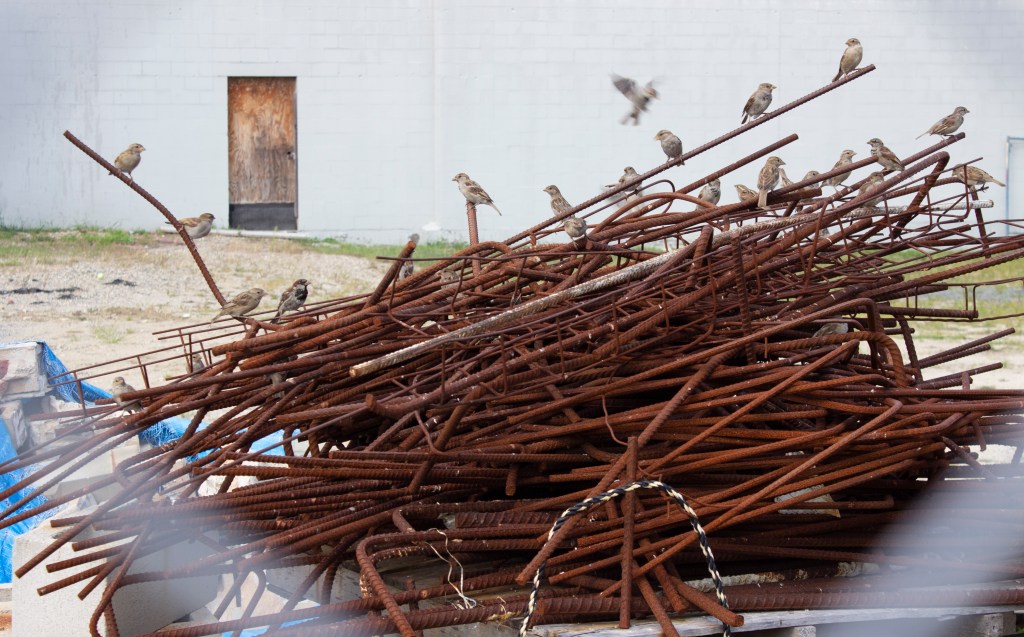
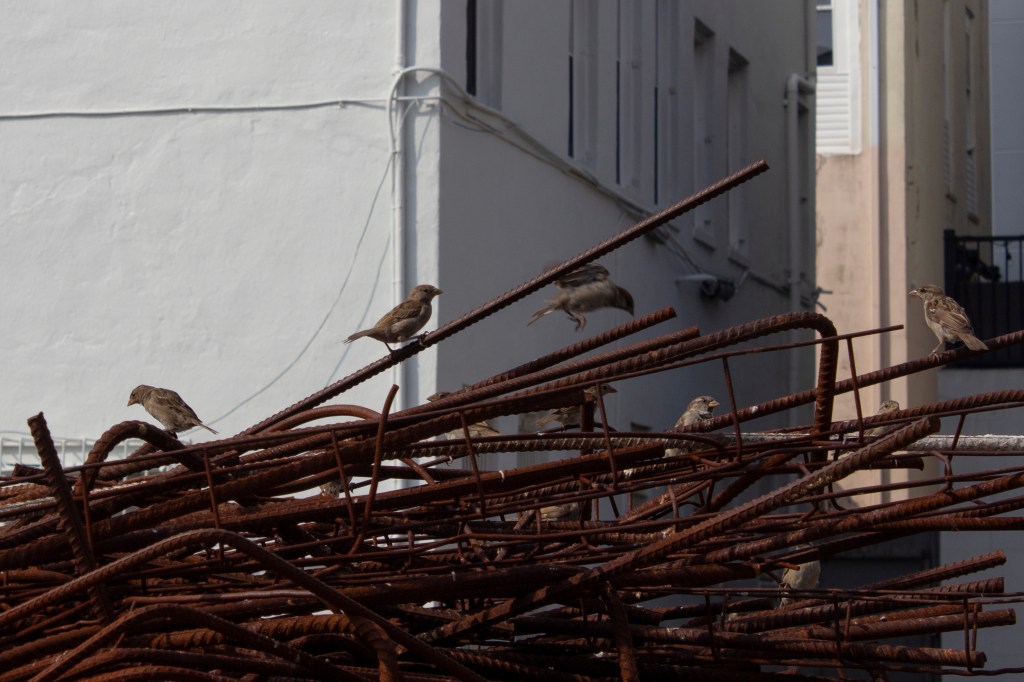
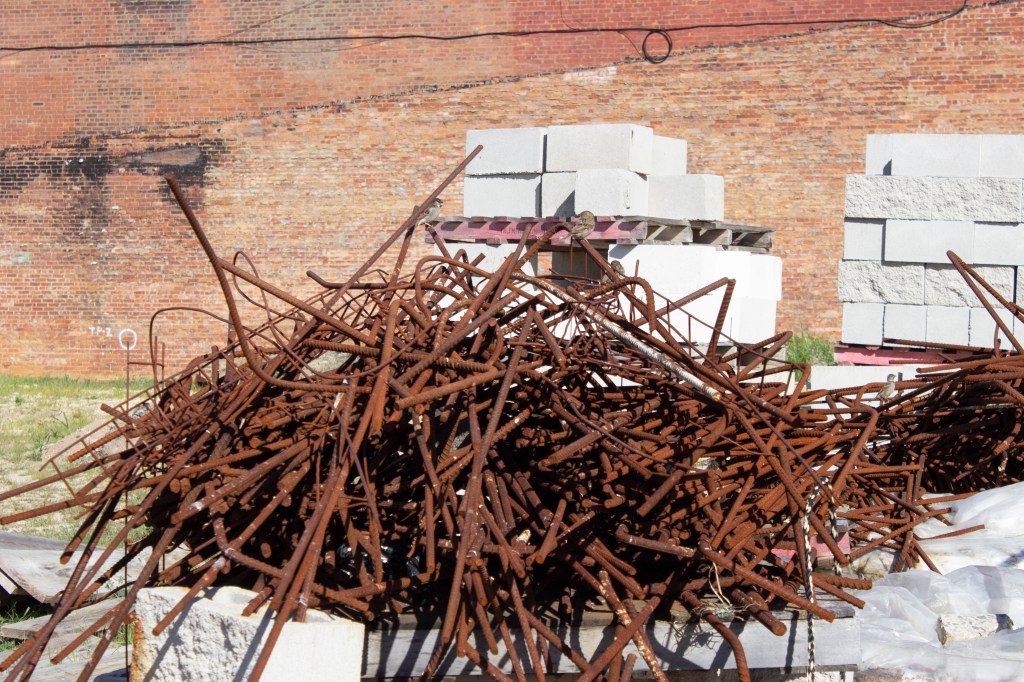
In any case, his thoughts on creating worlds in the befouled unworld brought to mind Psalm 84, which I have held in mind in connection to the photo I took of the sparrows on rusted beams in the lot of a demolition site.
*
*
Stiegler talks about the necessity to “believe in the possibility of a miracle“. At earlier moments in the book he refers to the miracles as parables for our mind to understand what is now becoming necessary in our befouled unworld. We might find it possible to go on only by “by creating worlds in our befouled unworld”.
Reflecting on these patterns brings my mind to Mary, and the miracle of the annunciation.
While reading True Devotion to Mary this morning, written by Saint Louis De Montfort, there was a rewriting of psalm 84 (83) that made the psalm become “about” Mary:
“Lord Jesus, how sweet are Thy tabernacles! The sparrow has found a house to lodge in, and the turtledove a nest for her little ones. Oh, happy is the man who dwells in the house of Mary, where Thou wast the first to make Thy dwelling! It is in this house of the predestinate that he receives assistance from Thee alone, and that he has arranged in his heart the steps and ascents of all the virtues by which to raise himself to perfection in this vale of tears. “How lovely are Thy tabernacles.” (PS. 83:2)
*
*

*
*
*
*

*
*
*

*

*
*

*

*

 theslowangel.com
Leave a comment