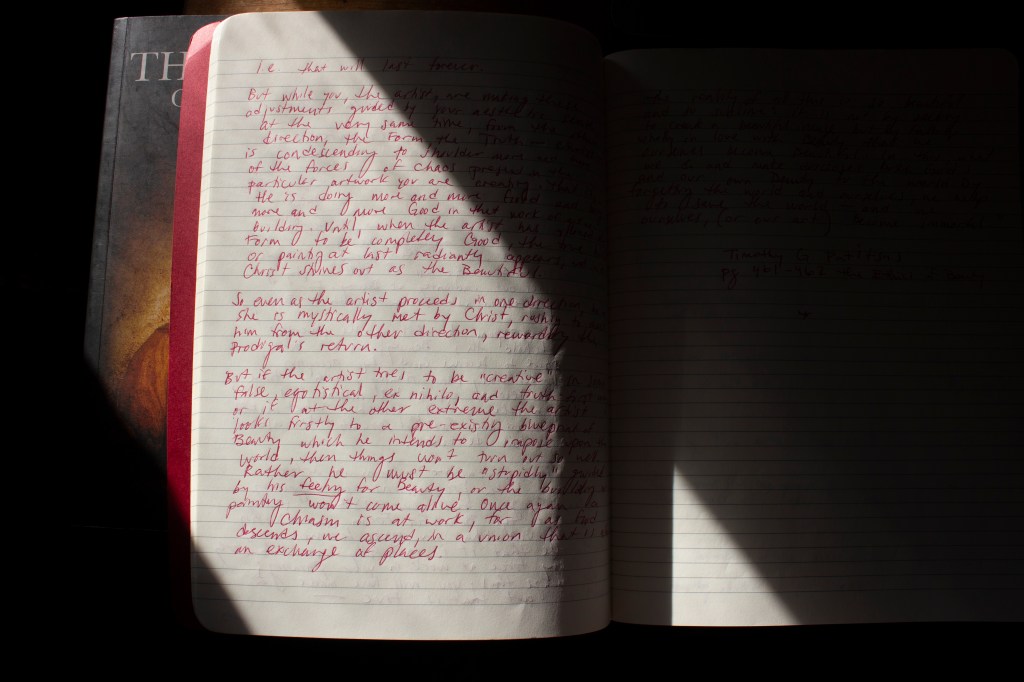
“One of the mistakes of our using the truth-first approach is that this approach belongs properly to Christ. He is the Logos, the Truth, who consents to the Goodness of self-emptying and thus shines out radiantly as Beauty. For Him, the progression is Truth-Goodness-Beauty.
We out to respond to this in the reverse: when we behold this Beauty, we are born, and then strive to become Good by accepting to live self-sacrificially, and finally, with time, we manage to become True. We mirror his progression, in other words, which is what makes us as “good and faithful servants.” We ascend where He has descended.
However, when you capture a form in art or architecture, both progressions are happening at once. You, going by your aesthetic feeling in response to the Beautiful Form, are adjusting and adjusting until what you make becomes good in the sense that it is faithfully and honestly bearing every force at work in your painting; if you manage this, you will have made a work of art that is true – i.e. that will last forever.
But while you, the artist, are making these adjustments guided by your aesthetic sense, at the very same time, from the other direction, the Form, the Truth – Christ – is condescending to shoulder more and more of the forces of chaos present in the particular artwork you are creating. That is, He is doing more and more Good and being more and more Good in that work of art or building. Until, when the artist has allowed the Form to be completely Good, the true building or painting at last radiantly appears, and in it Christ shines out as the Beautiful.
So even as the artist proceeds in one direction, he or she is mystically met by Christ, rushing to meet him from the other direction, rewarding the Prodigal’s return.
But if the artist tries to be “creative” in some false, egotistical, ex nihilo, and truth-first way, or if at the other extreme the artist looks firstly to a pre-existing blueprint of Beauty which he intends to impose upon the world, then things won’t turn out so well. Rather he must be “stupidly” guided by his feeling for Beauty, or the building or painting won’t come alive. Once again a chiasm is at work, for as a God descends, we ascend, in a union that is also an exchange of places.
The reality of all this is so beautiful and so sublime: it is not by seeking to create a beautiful image but by falling wholly in love with Beauty that we ourselves become Beautiful. In this, what we do and make discloses both God’s and our own Beauty to the world. By forgetting the world and ourselves, we help to save the world – and we ourselves, (or our art) become “immortal.” “
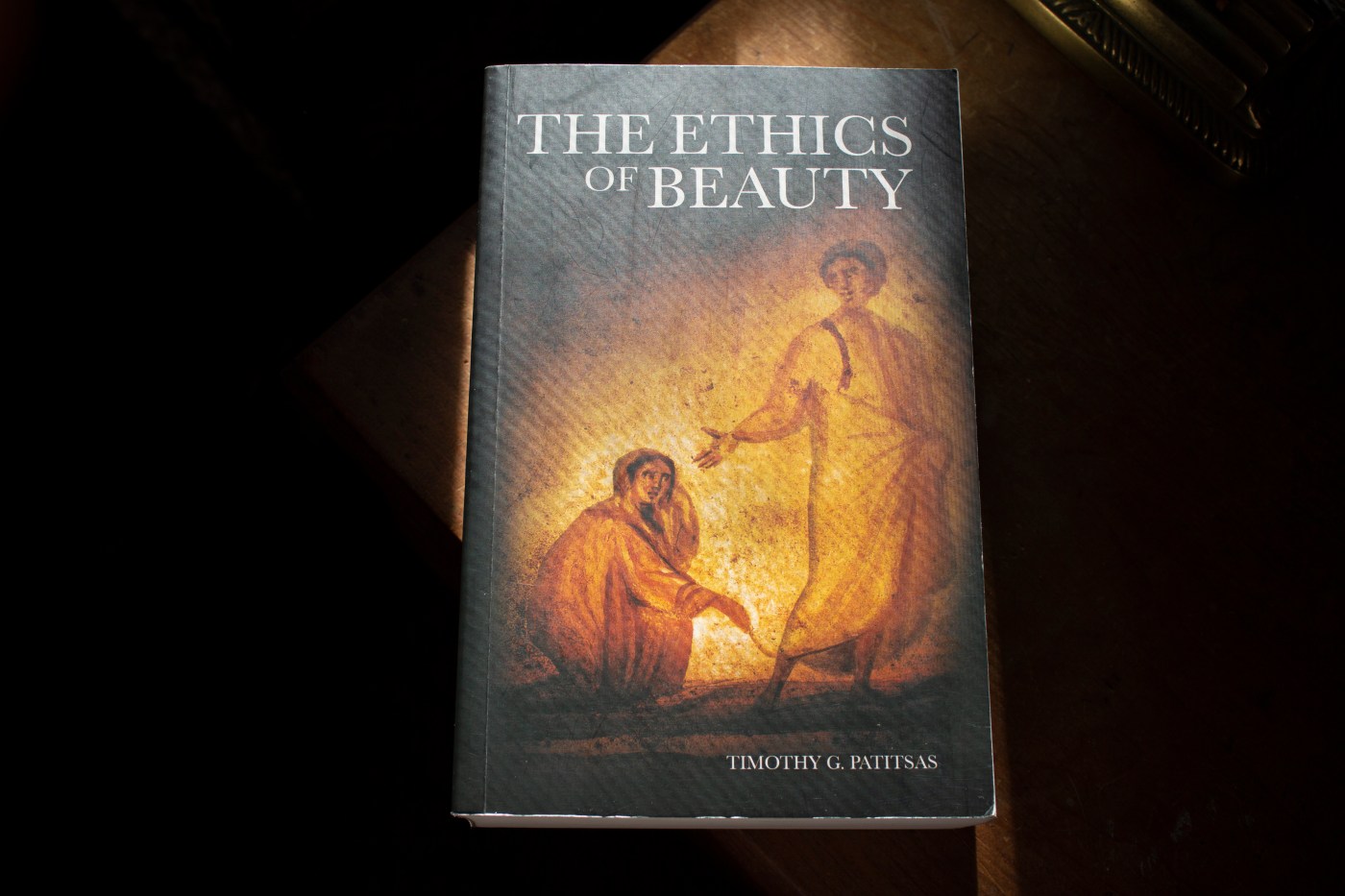
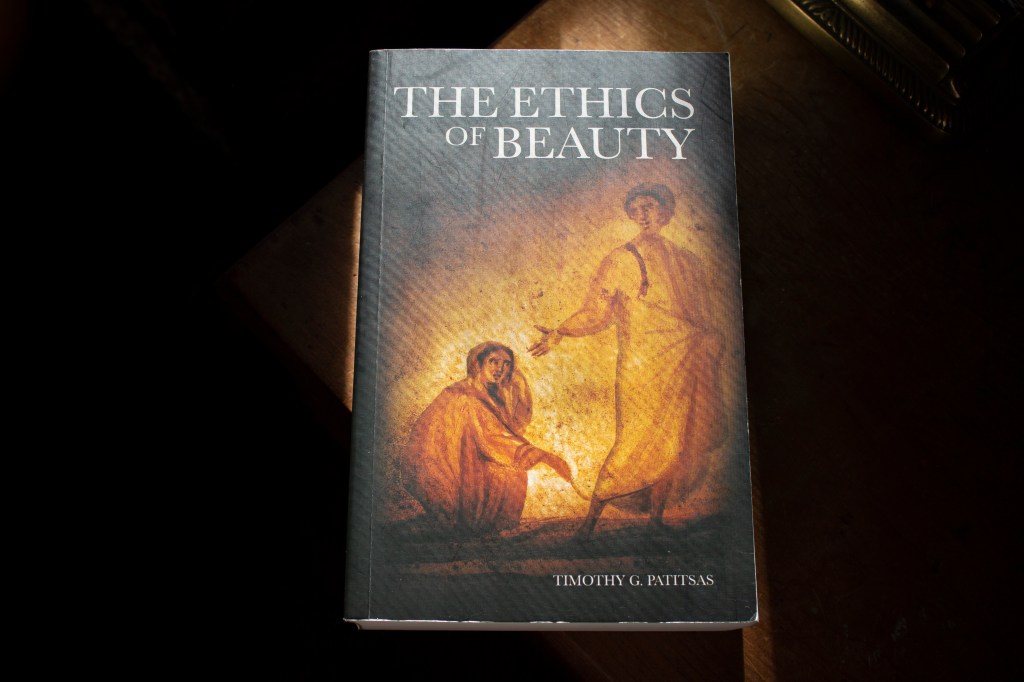
Timothy G. Patitsas, The Ethics of Beauty pg 461-462
*
*
 theslowangel.com
Leave a comment